
What Is NFPA 70E? The Complete Guide for Electrical Safety Professionals
Every year, hundreds of workers die from electrical injuries and thousands more are hospitalized. Not because the hazards were unforeseeable, but because the right safety frameworks were not in place. In the United States alone, electrical incidents are among the leading causes of occupational fatality. Across the Gulf, where oil and gas, construction, and industrial expansion are accelerating under Vision 2030, the electrical safety risk profile is rising alongside the pace of development.
The standard that exists precisely to prevent these incidents is NFPA 70E, the Standard for Electrical Safety in the Workplace. If you work with or around electricity professionally, or if you are responsible for the safety of those who do, NFPA 70E is the framework that governs how electrical hazards are identified, assessed, and controlled. This guide explains what the standard covers, why it matters, who needs to comply, and how formal NFPA 70E training translates the standard into verifiable workplace competence.
What Is NFPA 70E?
NFPA 70E is the Standard for Electrical Safety in the Workplace, published by the National Fire Protection Association (NFPA). It defines the safety-related work practices, procedures, and programme requirements that organisations must implement to protect workers from the hazards of electricity, including electric shock, arc flash, arc blast, and electrical fire.
Originally developed at the direct request of the Occupational Safety and Health Administration (OSHA), NFPA 70E was created to give employers and workers a practical, technically detailed framework for managing electrical safety in the workplace, covering everything from how to establish an electrically safe work condition to how to select and maintain arc-rated personal protective equipment (PPE).
The standard is updated every three years and is now in its 2024 edition. It is referenced by OSHA in 29 CFR 1910 Subpart S (electrical standards for general industry) and 29 CFR 1926 Subpart K (electrical standards for construction), making compliance with NFPA 70E the accepted method for demonstrating OSHA compliance in electrical safety matters.
Why NFPA 70E Exists – The Electrical Hazards It Addresses
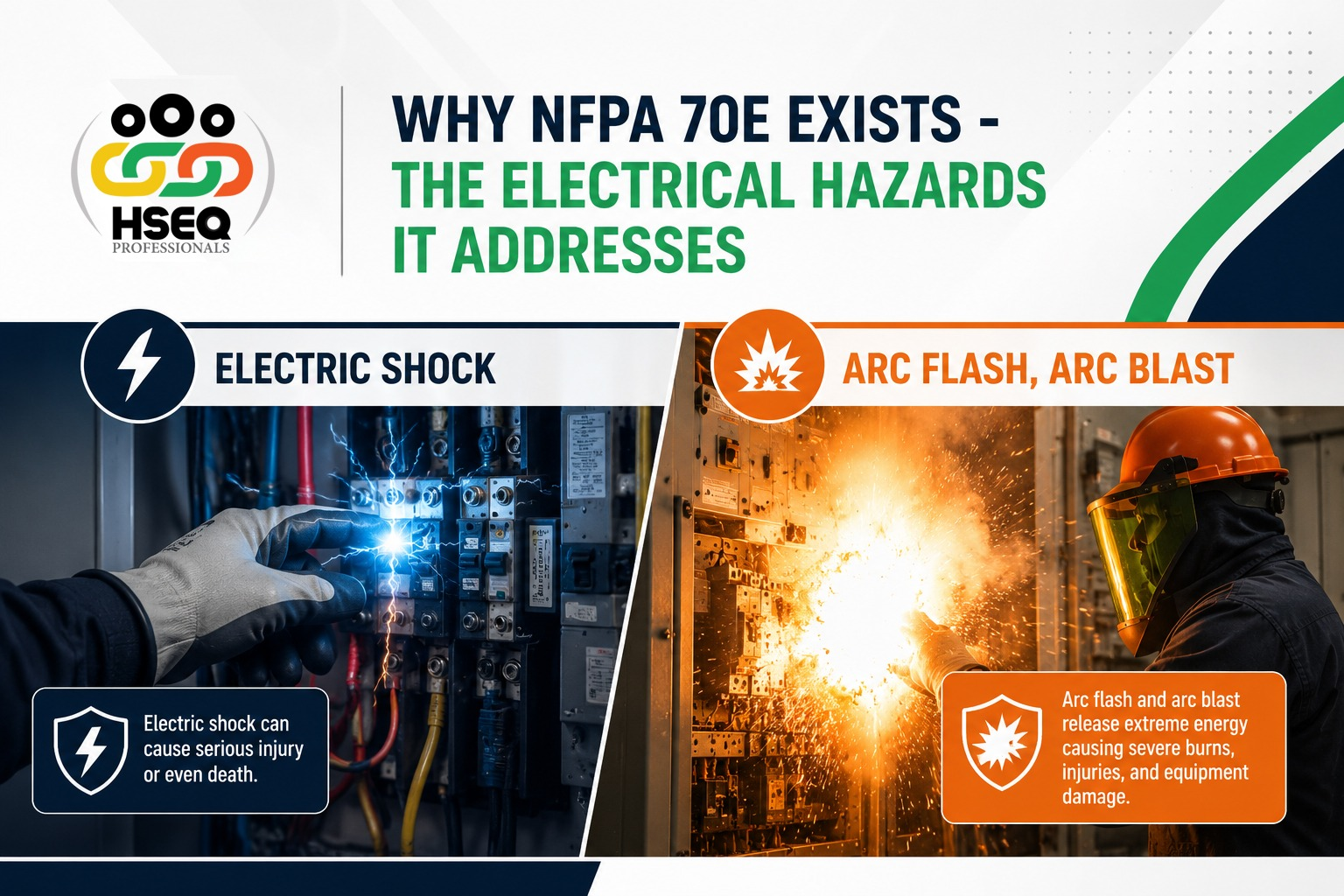
The standard exists because electrical hazards are uniquely dangerous, and uniquely preventable. The three primary hazard categories that NFPA 70E addresses are:
-
Electric Shock
Shock occurs when a worker becomes part of an electrical circuit, either by direct contact with an energised conductor or indirectly through a conducting object. At low currents, shock causes pain and involuntary muscle contraction. At higher currents, it causes ventricular fibrillation, cardiac arrest, severe burns, and death. NFPA 70E establishes shock protection boundaries, the distances from energised parts within which only qualified personnel may work, and beyond which unqualified personnel must remain.
-
Arc Flash
Arc flash is the explosive release of energy caused by an electrical arc fault, a flash of plasma that can reach temperatures of 35,000 degrees Fahrenheit (nearly four times the surface temperature of the sun). Arc flash produces intense heat, blinding light, a pressure wave, and a shower of molten metal. It can cause severe burns, permanent blindness, hearing loss, and fatal injury to workers who are not wearing appropriate arc-rated PPE and who are within the arc flash boundary at the time of the event.
Arc flash is responsible for significant electrical fatalities and injuries globally. NFPA 70E requires a formal electrical hazard analysis, including arc flash hazard analysis, before any work on or near energised electrical equipment. It specifies two methods for determining PPE requirements: the incident energy method (which calculates the actual energy a worker could receive at a given distance) and the table method (which uses standardised PPE categories based on equipment type and task).
-
Arc Blast
Arc blast is the pressure wave generated by an arc flash event. The rapid vaporisation of conducting material produces a shockwave that can rupture eardrums, crush internal organs, throw workers across rooms, and damage structures. Workers closest to the arc event are most at risk. Arc-rated PPE that protects against the thermal effects of arc flash does not fully protect against the mechanical effects of arc blast, which is why NFPA 70E also mandates approach boundary restrictions and engineering controls to reduce the probability of arc events occurring in the first place.
NFPA 70E vs OSHA: How They Work Together
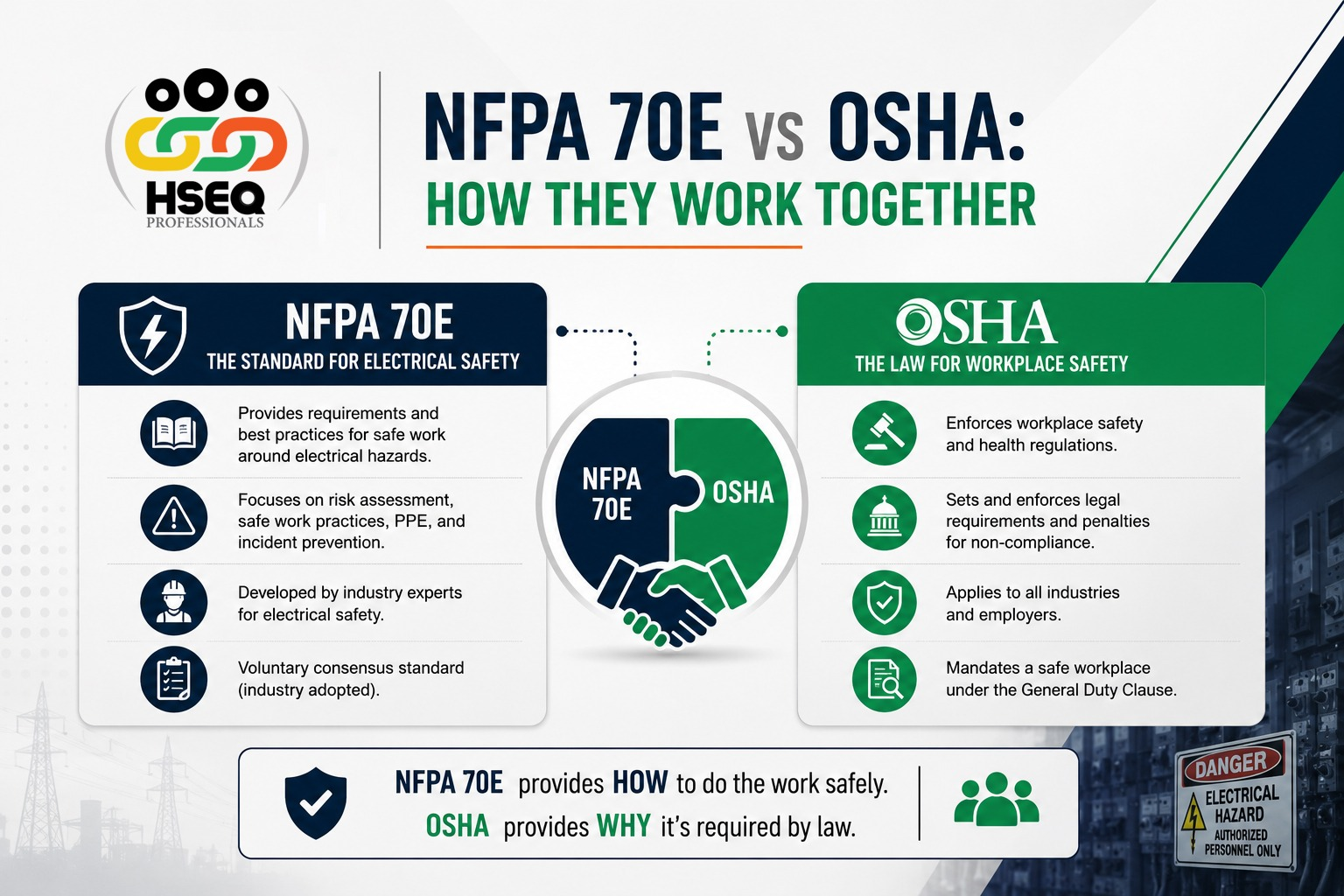
One of the most common points of confusion among safety professionals is the relationship between NFPA 70E and OSHA. They are not competing frameworks, they are complementary ones. Understanding the relationship is fundamental to building a legally defensible electrical safety programme.
OSHA sets the legal obligation: employers must provide a workplace free from recognised electrical hazards (29 CFR 1910 and 1926). OSHA does not, however, specify precisely how to meet that obligation for electrical safety, it sets the outcome, not the method. NFPA 70E fills that gap. It provides the technically detailed, consensus-based methodology that OSHA inspectors use as the benchmark when evaluating electrical safety programmes and investigating electrical incidents.
In practice: if a worker is injured in an electrical incident and OSHA investigates, the question will be whether the employer’s electrical safety programme met the requirements of NFPA 70E. If it did not, if there was no arc flash hazard analysis, if PPE was not properly selected, if the lockout/tagout programme was incomplete, the employer faces citation and significant liability. NFPA 70E compliance is therefore not just an ethical obligation. It is a legal and commercial one.
Who Needs NFPA 70E Training?
NFPA 70E applies to any workplace where employees may be exposed to electrical hazards during the course of their work. This is not limited to electricians, it covers everyone who works on, with, or near energised electrical equipment, and every manager or safety professional responsible for their protection.
|
Industrial & Manufacturing |
Oil, Gas & Energy | Construction & Infrastructure |
|
Electrical engineers and supervisors responsible for energised equipment and switchgear operations |
Facility HSE professionals managing electrical safety compliance at upstream and downstream sites |
Project managers and electrical contractors on construction sites with high-voltage installations |
| Maintenance engineers overseeing equipment inspection, testing, and repair in live electrical environments |
Plant and operations managers accountable for OSHA and NFPA 70E compliance at processing facilities |
Risk managers and safety officers developing electrical safety programmes for Vision 2030 projects |
The standard distinguishes between qualified persons, those trained and competent to work on or near energised electrical equipment and unqualified persons, those who must remain outside the limited approach boundary. Both categories have obligations under NFPA 70E: qualified persons must be able to perform work safely and select appropriate PPE; unqualified persons must be trained to recognise electrical hazards and understand approach boundaries. A comprehensive NFPA 70E electrical safety training programme addresses both groups.
What Does NFPA 70E Training Cover? The 13-Module Curriculum
Formal NFPA 70E training does not simply read the standard aloud. A well-designed course translates the standard’s requirements into practical competencies, the ability to conduct a hazard analysis, establish an electrically safe work condition, select appropriate PPE, build an electrical safety programme, and prepare for CESCP, CESW, or CEST certification examination.
HSEQ Professionals’ Electrical Safety Specialist Course delivers 40 hours of structured NFPA 70E training across 13 modules, designed specifically as a preparatory course for all three NFPA electrical safety certifications:
|
Module |
Topic | What You Learn |
|
01 |
Introduction to Electrical Safety |
Importance of NFPA 70E, course objectives, regulatory foundation |
|
02 |
Electrical Hazard Analysis |
Shock, arc flash, arc blast hazards — causes, effects, and injury mechanics |
|
03 |
Electrical Safety Fundamentals |
Relationship between NFPA 70E and OSHA, scope, key definitions |
|
04 |
Electrical Safety Program Components |
Employer/employee responsibilities, qualified person requirements, safety program principles |
|
05 |
Establishing an Electrically Safe Work Condition |
Lockout/tagout (LOTO) program, principles, equipment and procedure requirements |
|
06 |
Working While Exposed to Electrical Hazards |
Energised work permits, arc flash boundaries, PPE determination methods, equipment labelling |
|
07 |
Personal Protective Equipment |
PPE types, arc-rated clothing selection, care and maintenance, tool requirements |
|
08 |
Equipment Maintenance |
Maintenance of overcurrent devices, circuit breakers, flexible cords, portable tools |
|
09 |
Hazard Recognition for Special Equipment |
Battery room hazards, power electronic equipment, specialist PPE requirements |
| 10 | Layering of Protective Clothing |
Arc-rated clothing layers, natural fibre underlayers, total system arc rating calculations |
|
11 |
Working Near Overhead and Underground Lines |
Overhead Power Line Policy, high-risk tasks, heavy equipment, emergency response |
|
12 |
Safety-Related Design Requirements |
Incident energy reduction methods, safety-by-design principles, arc flash label requirements |
| 13 | Human Performance and Workplace Safety |
Human performance principles, error precursors, workplace culture, performance tools |
NFPA Electrical Safety Certifications: CESCP, CESW, and CEST Explained
NFPA 70E training prepares professionals for formal certification through NFPA’s electrical safety certification programme. There are three distinct certifications, each designed for a different professional profile. Understanding which certification applies to your role and your team’s roles is important before selecting a training programme.
|
Certification |
CESCP | CESW | CEST |
|
Full name |
Certified Electrical Safety Compliance Professional | Certified Electrical Safety Worker |
Certified Electrical Safety Technician |
|
Primary audience |
Engineers, safety managers, and trainers who design and manage electrical safety programmes | Electricians and workers who perform hands-on electrical tasks in the field |
Technicians who support electrical safety operations and maintenance activities |
|
Focus |
Programme development, compliance, auditing, and training delivery | Practical field safety — energised work, LOTO, PPE application |
Technical operations, equipment maintenance, and hazard recognition |
| Pass mark | 70% minimum on NFPA computer-based exam | 70% minimum on NFPA computer-based exam |
70% minimum on NFPA computer-based exam |
All three certifications are based on the NFPA 70E Standard and require passing a computer-based examination. HSEQ Professionals’ 40-hour Electrical Safety Specialist Course is structured to prepare participants for all three examinations, making it suitable for cross-functional teams where electrical engineers, field electricians, and technical support staff may all attend the same course intake.
How to Build an NFPA 70E-Compliant Electrical Safety Programme
Training is a critical component of electrical safety compliance, but it is not the complete picture. An NFPA 70E-compliant electrical safety programme requires five structural elements that training alone enables but does not deliver:
- Electrical hazard analysis: A systematic assessment of all electrical hazards present in your workplace, shock, arc flash, and arc blast, for every relevant piece of equipment and every task performed on or near it. This includes arc flash studies, boundary calculations, and equipment labelling.
- Electrically safe work condition (ESWC) procedures: Documented lockout/tagout (LOTO) procedures for every circuit and piece of equipment that must be de-energised for maintenance, inspection, or repair. LOTO is the cornerstone of electrical safety compliance.
- Energised electrical work permits: A documented justification and control framework for any work that must be performed on live equipment, because establishing an ESWC is infeasible or creates greater hazard. Permits must document the hazard analysis, the PPE required, and the authorisation chain.
- PPE selection, inspection, and maintenance programme: A documented system for selecting arc-rated PPE appropriate to the incident energy at each work location, inspecting PPE before each use, and maintaining and replacing PPE in accordance with manufacturer requirements and NFPA 70E Annex requirements.
- Training and competency management: Documented NFPA 70E training for all qualified persons, with periodic retraining when the standard is updated (every three years), when an incident occurs, or when an employee is observed working unsafely. Training records must be retained and available for OSHA inspection.
For organisations requiring technical support in developing, auditing, or reviewing their electrical safety programme alongside NFPA 70E, HSEQ Professionals’ technical and auditing services team provides structured compliance assessments and programme development support.
NFPA 70E Training in Saudi Arabia: What Electrical Professionals Need to Know
In Saudi Arabia, electrical safety in industrial and commercial settings is governed by the Saudi Electricity Company (SEC) technical standards, which draw on international frameworks including NFPA standards for high-voltage and industrial applications. For organisations working within Aramco’s supply chain, SABIC’s industrial facilities, or on NEOM and other major Vision 2030 projects, NFPA 70E competence is increasingly a prequalification expectation, particularly for electrical contractors, HSE professionals, and facility managers on these projects.
The practical demand for NFPA 70E training in Saudi Arabia is driven by three realities. First, the scale and pace of Vision 2030 construction and industrial development has brought large numbers of qualified electrical workers and safety professionals into high-voltage environments where arc flash risk is significant. Second, Saudi and international companies operating in the Kingdom face dual compliance obligations, local SEC requirements and the international standards required by global clients and investors.
Third, as Saudi Arabia develops its domestic safety professional workforce as part of Vision 2030’s Saudisation objectives, formal international certifications like CESCP and CESW are increasingly sought by Saudi nationals in engineering and HSE roles.
HSEQ Professionals delivers the Electrical Safety Specialist Course from offices in Jeddah and Riyadh, the two cities at the centre of Vision 2030’s industrial and infrastructure development. The course is available in both English and Arabic, with online delivery also available for participants across the GCC who cannot attend in person. For organisations sending multiple staff from the same facility, in-house corporate delivery at your Riyadh or Jeddah location can be arranged.
Frequently Asked Questions About NFPA 70E
-
Is NFPA 70E a legal requirement?
NFPA 70E is not a law, it is a consensus standard published by NFPA. However, OSHA references it as the accepted methodology for electrical safety compliance under 29 CFR 1910 and 1926. In practice, this means that failure to follow NFPA 70E principles is treated as a failure to meet OSHA requirements. OSHA inspectors use NFPA 70E as the benchmark when investigating electrical incidents. Non-compliance results in OSHA citations, significant fines, and civil liability in the event of injury or death.
-
How often is NFPA 70E updated?
NFPA 70E is revised on a three-year cycle. The current edition is NFPA 70E:2024. Previous editions were published in 2021, 2018, 2015, and so on. Each new edition incorporates technical revisions, clarifications, and updates reflecting industry experience and new research. Electrical safety professionals and programme managers should review their safety programmes and update their training whenever a new edition is published.
-
What is the difference between NFPA 70E and NFPA 70?
NFPA 70 is the National Electrical Code (NEC), it governs the installation of electrical wiring and equipment to prevent fire and electric shock from defective or improperly installed systems. NFPA 70E governs the safe work practices and procedures that protect workers who must work on or near electrical systems that are already installed. In simple terms: NFPA 70 covers how electrical systems should be built; NFPA 70E covers how workers should safely interact with those systems.
-
How long does NFPA 70E training take?
A comprehensive NFPA 70E training programme covering all 13 modules and preparing participants for CESCP, CESW, or CEST certification takes 40 hours (5 days). Shorter awareness-level courses are available for workers who need hazard recognition training without full certification preparation. HSEQ Professionals’ NFPA 70E Electrical Safety Specialist Course is the full 40-hour programme, delivered as an instructor-led course with a 60-minute final assessment.
-
Who should attend NFPA 70E training in Saudi Arabia?
Any electrical engineer, safety professional, facility manager, maintenance engineer, electrical contractor, or HSE officer who works with or near energised electrical systems in Saudi Arabia should complete NFPA 70E training. This is particularly relevant for professionals working on Aramco, SABIC, or NEOM-related projects, where NFPA 70E competence is expected and sometimes explicitly required in contractor qualification documents.
Enroll in NFPA 70E Training with HSEQ Professionals
HSEQ Professionals is an accredited training provider with over 125 years of combined HSEQ expertise, delivering NFPA 70E electrical safety training from offices in Jeddah, Riyadh, Karachi, and Lahore, and online globally. Our Electrical Safety Specialist Course is the region’s most comprehensive 40-hour NFPA 70E programme, built specifically to prepare participants for CESCP, CESW, and CEST certification.
We also deliver a full range of NFPA training courses and HSEQ occupational safety training for organisations across Saudi Arabia, the GCC, and Pakistan.
Contact our team to discuss your NFPA 70E training requirements, enquire about upcoming course dates in Saudi Arabia, or arrange an in-house corporate programme for your electrical safety team.