
Arc Flash Hazard Analysis: What It Is and How to Conduct One
In the time it takes to blink, an arc flash event can release tens of thousands of degrees of thermal energy, enough to instantly vaporise metal, ignite clothing, and fatally burn a worker standing several metres away. Unlike many workplace hazards, arc flash gives no warning. There is no smell, no colour change, no gradual escalation. There is simply the normal state of energised electrical equipment and then the arc event.
The tool that stands between a worker and that outcome is the arc flash hazard analysis, a systematic, engineering-based process that quantifies the energy a worker could be exposed to during an arc flash event, determines the boundaries within which that risk exists, and specifies the arc flash PPE required to survive it.
Across Saudi Arabia and the wider GCC, where the scale and pace of industrial development under Vision 2030 is placing more workers in proximity to high-energy electrical systems than at any previous point in the Kingdom’s history, arc flash hazard analysis is no longer a compliance exercise reserved for international companies. It is a fundamental workplace safety requirement.
This guide explains what arc flash is, why arc flash hazard analysis is required under NFPA 70E, how to conduct one step by step, and how arc flash training translates the technical requirements of the standard into verifiable, practical competence for electrical workers and safety professionals.
What Is Arc Flash?
An arc flash is the explosive release of energy that occurs when an electrical current passes through the air between two conductors or from a conductor to ground, an arc fault. Unlike a direct short circuit, where current flows through a physical connection, an arc travels through ionised air plasma and sustains itself with enormous energy release.
The consequences of an arc flash event depend on the available fault current, the arc gap, the duration of the arc (determined by how quickly the protective device operates to clear the fault), and the distance between the arc and the worker. At its most severe, an arc flash produces:
- Temperatures up to 35,000 degrees Fahrenheit (19,400 degrees Celsius), approximately four times the surface temperature of the sun at the arc point, capable of instantly vaporising copper and steel conductors.
- A radiant heat wave that travels outward from the arc point at the speed of light, capable of causing severe burns at distances of several metres from the arc location.
- A pressure wave (arc blast) produced by the rapid vaporisation of conducting material, generating a shockwave that can rupture eardrums, cause internal injuries, and throw workers across a room.
- Molten metal and shrapnel expelled from the arc point at high velocity, capable of penetrating skin and igniting arc-rated clothing if the PPE is inadequate for the incident energy level.
- Intense light in ultraviolet and infrared spectra, capable of causing permanent eye damage and retinal burns in unprotected workers.
The critical variable that determines injury severity is incident energy, the amount of thermal energy that reaches a worker’s body surface at a specified working distance from the arc, expressed in calories per square centimetre (cal/cm²). 1.2 cal/cm² is the threshold at which an unprotected worker will sustain a second-degree burn. Arc flash events in industrial electrical systems routinely produce incident energy levels of 20, 40, or more cal/cm², far beyond the survival threshold for unprotected or inadequately protected workers.
What Is Arc Flash Hazard Analysis?
Arc flash hazard analysis is the engineering study that determines the arc flash risk at each piece of electrical equipment in a facility, calculating the available incident energy, establishing the arc flash boundary, and specifying the minimum PPE required for any worker who must work on or near that equipment while it is energised.
Under NFPA 70E Section 130.5, an arc flash hazard analysis is required before any worker may approach closer to energised electrical equipment than the restricted approach boundary. It is not optional, it is not a one-time activity, and it cannot be replaced by simply issuing higher-rated PPE without understanding the actual energy involved. Issuing 40 cal/cm² PPE to a worker exposed to 60 cal/cm² of incident energy does not make that worker safe, it simply means they are wearing inadequate protection.
The arc flash hazard analysis produces three critical outputs that must be applied at every piece of equipment covered by the study:
- Incident energy at working distance: The calculated thermal energy (cal/cm²) a worker would receive at the specified working distance from the arc, which determines the minimum arc rating of the PPE required.
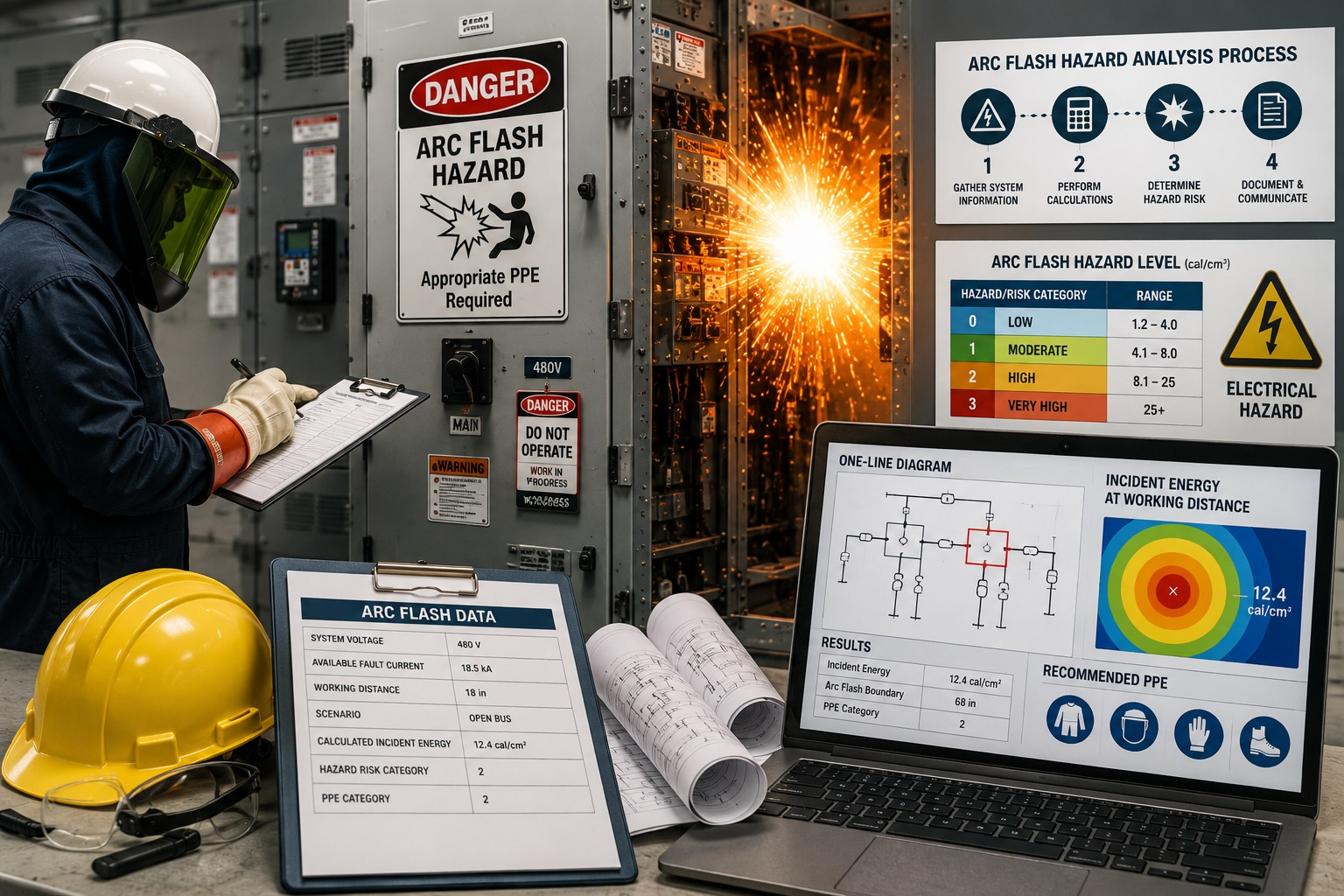
- Arc flash boundary: The distance from the prospective arc point at which incident energy equals 1.2 cal/cm². No worker may enter this boundary without appropriate arc-rated PPE.
- Arc flash warning label: Applied directly to the equipment, displaying the incident energy, arc flash boundary, PPE requirement, restricted approach boundary, and the date of the study.
NFPA 70E Requirements for Arc Flash Hazard Analysis
NFPA 70E Section 130.5 establishes the requirements for arc flash risk assessment. The standard requires that the assessment determine the arc flash boundary and the PPE required within that boundary and it provides two methods for doing so:
-
Method 1 – The Incident Energy Analysis Method (IEEE 1584)
The incident energy analysis method uses the IEEE 1584 Guide for Performing Arc Flash Hazard Calculations, a consensus-based engineering standard that provides empirically validated equations for calculating incident energy based on system parameters. This method produces a specific incident energy value (cal/cm²) for each piece of equipment based on the actual electrical system configuration, available fault current, and protective device clearing time.
The incident energy analysis method is the more rigorous of the two approaches and is required for equipment where the table method is not applicable, including most medium and high-voltage equipment, and any system where the fault current or operating conditions fall outside the table method’s boundaries. It requires a full power systems study and is typically conducted using specialist power systems analysis software by qualified electrical engineers.
-
Method 2 – The PPE Category (Table) Method
The PPE category method uses standardized tables in NFPA 70E to assign a PPE category (1 through 4) based on the type of equipment and the task being performed. Each PPE category has a defined minimum arc rating, and workers select PPE that meets or exceeds that rating. The table method is simpler to apply than the incident energy method but has limitations, it cannot be used for equipment where the available fault current exceeds the table boundaries, and it does not produce an actual incident energy value for equipment labelling.
For organisations with straightforward, low-to-medium voltage electrical systems and clear task definitions, the PPE category method provides a practical and compliant approach. For large industrial facilities, process plants, oil and gas installations, and any system with medium-voltage equipment, common across Saudi Arabia’s industrial sector, the incident energy analysis method is the appropriate approach.
How to Conduct an Arc Flash Hazard Analysis: Step by Step
A full arc flash hazard analysis for an industrial facility is an engineering study that requires qualified electrical engineers, power systems analysis software, and access to accurate as-built electrical system drawings. The process follows a defined sequence:
|
Step |
Action |
Detail |
|
1 |
Collect electrical system data |
Gather single-line diagrams, equipment ratings, conductor sizes, lengths, and impedance values. Include utility supply data (available fault current, X/R ratios). Outdated drawings are one of the most common causes of inaccurate arc flash studies, verify drawings against current installed conditions before proceeding. |
|
2 |
Build or verify the system model |
Enter all collected data into power systems analysis software (commonly SKM Power*Tools, ETAP, or EasyPower). Model all buses, cables, transformers, and protective devices from the utility connection down to the equipment being assessed. Include all switching configurations that occur during normal operations. |
|
3 |
Conduct a short circuit (fault current) study |
Calculate the maximum and minimum available bolted fault current at every bus in the system. Both maximum and minimum fault currents are needed, maximum determines the highest potential incident energy; minimum determines the lowest fault current the protective device must interrupt, which affects clearing time. |
|
4 |
Conduct a protective device coordination study |
Analyse how overcurrent protective devices (fuses, circuit breakers, relays) operate in sequence during a fault. Confirm that devices are correctly coordinated so that the protective device closest to the fault operates first and clears the fault in the shortest possible time. Coordination directly determines incident energy, faster clearing time means lower incident energy. |
|
5 |
Calculate incident energy and arc flash boundaries |
Using the fault current data and protective device clearing times, calculate the incident energy (in cal/cm²) at the working distance for each piece of equipment. Determine the arc flash boundary – the distance at which incident energy equals 1.2 cal/cm², the threshold for a second-degree burn. Both the incident energy method (IEEE 1584) and NFPA 70E Table method are acceptable approaches. |
|
6 |
Determine arc flash PPE requirements |
Select PPE appropriate to the calculated incident energy level using the NFPA 70E arc-rated PPE categories. Where incident energy exceeds 40 cal/cm², additional engineering controls should be implemented to reduce incident energy before allowing work, not simply specifying higher-rated PPE. |
|
7 |
Label all equipment |
Apply arc flash warning labels to all equipment covered by the study. Labels must include: equipment identifier, date of the study, arc flash boundary distance, incident energy at working distance, PPE category, and restricted approach boundary. NFPA 70E 130.5(H) specifies the minimum labelling requirements. |
|
8 |
Document findings and implement controls |
Produce a formal arc flash study report documenting all calculations, assumptions, and results. Update single-line diagrams. Implement any recommended engineering controls (arc flash mitigation, relay setting updates, zone-selective interlocking). Brief all workers who perform tasks on affected equipment. |
|
9 |
Review and update at defined intervals |
NFPA 70E requires the arc flash hazard analysis to be reviewed and updated when changes to the electrical system are made, when major modifications to equipment occur, or when the protective device settings are altered. As a minimum, review the study every five years or whenever a significant electrical incident occurs. |
Arc Flash Protection: Understanding the Boundaries
NFPA 70E defines a set of approach boundaries around energised electrical equipment that govern how different categories of personnel may approach and what arc flash protection is required at each distance. Understanding these boundaries is fundamental to any electrical safety programme and to the application of arc flash hazard analysis results.
-
Limited Approach Boundary
The distance from an energised electrical conductor or circuit part at which a shock hazard exists. Unqualified persons (those without specific electrical safety training) may not cross this boundary without an escort by a qualified person. Qualified persons may cross this boundary but must be trained in the associated shock hazard.
-
Restricted Approach Boundary
The distance from an energised conductor within which there is an increased risk of shock due to electrical arc-over combined with inadvertent movement. Crossing this boundary requires a qualified person, an energised work permit, insulated tools, and appropriate shock protection PPE. Only qualified persons with specific training for the task may cross the restricted approach boundary.
-
Arc Flash Boundary
The distance from the prospective arc point at which incident energy equals 1.2 cal/cm², the onset of a second-degree burn for an unprotected worker. No person may enter the arc flash boundary without arc-rated PPE rated to at least the calculated or assigned incident energy level. The arc flash boundary is determined by the arc flash hazard analysis and is unique to each piece of equipment and task combination.
Arc Flash PPE: Selection, Categories, and Requirements
Arc-rated arc flash PPE is specifically designed to protect workers from the thermal effects of an arc flash event. Standard flame-resistant (FR) clothing is not the same as arc-rated PPE, FR clothing resists ignition but does not provide a defined, tested level of protection against incident energy. Arc-rated PPE has been tested to an arc thermal performance value (ATPV) or energy break-open threshold (EBT) expressed in cal/cm², which must equal or exceed the incident energy at the working location.
NFPA 70E organizes arc flash PPE into four categories based on minimum arc rating requirements. The table below summarises each category, its minimum arc rating, the tasks it typically applies to, and the PPE components required:
|
PPE Category |
Min Arc Rating | Typical Tasks |
Required PPE |
|
1 |
4 cal/cm² | Inspecting open switchgear below 240V, reading panel meters |
Arc-rated shirt and trousers, arc-rated face shield (min 4 cal/cm²), safety glasses, hard hat, leather gloves. |
|
2 |
8 cal/cm² | Removing covers from energised equipment below 600V, racking in/out breakers |
Category 1 PPE plus arc-rated jacket or switching coat (min 8 cal/cm²), hearing protection. |
|
3 |
25 cal/cm² | Working on energised 600V–15kV equipment, installing short circuit protective devices |
Arc-rated suit (min 25 cal/cm²), arc-rated balaclava, arc-rated face shield, hard hat, hearing protection, leather gloves. |
|
4 |
40 cal/cm² | High-voltage switching operations above 15kV, work on energised bus bars |
Arc-rated suit (min 40 cal/cm²), arc flash hood, arc-rated gloves, leather boots, hearing protection, hard hat. |
Critical PPE Selection Rules
- The arc rating of the selected PPE must equal or exceed the incident energy calculated in the arc flash hazard analysis or assigned by the PPE category method. Never select PPE that is rated below the incident energy at the working location.
- Arc-rated PPE must be worn as a complete system, all layers must be arc-rated. A non-arc-rated garment worn under arc-rated outer clothing can trap heat and increase injury severity.
- Natural fibre underlayers (100% cotton or wool) are permitted beneath arc-rated outer layers. Synthetic fibres (polyester, nylon, rayon) are not permitted, they melt and adhere to skin, dramatically worsening burn injuries.
- Arc-rated face protection is always required within the arc flash boundary, not optional. The face is the most exposed and vulnerable surface in an arc flash event.
- PPE must be inspected before each use for damage, contamination, or deterioration. Contaminated arc-rated clothing (by flammable liquids, oils, or grease) must be cleaned or replaced before use.
- Arc-rated clothing loses protective performance when laundered with fabric softeners or bleach. Always follow manufacturer laundering instructions.
Reducing Arc Flash Incident Energy: Engineering Controls First
NFPA 70E Section 130.5(G) requires that when an arc flash hazard analysis determines that the incident energy at a working location exceeds 40 cal/cm², the employer must implement methods to reduce incident energy before workers may perform tasks at that location, not simply issue higher-rated PPE. This reflects the hierarchy of controls principle: engineering controls that eliminate or reduce the hazard at the source are always preferred over PPE, which only limits the consequences of exposure.
The following engineering methods are available to reduce arc flash incident energy. All involve reducing either the available fault current or the time that current flows during an arc event, the two primary variables that determine incident energy:
|
Method |
How it reduces incident energy |
Best suited for |
|
High-resistance grounding (HRG) |
Limits ground fault current, significantly reducing arc flash energy for ground fault events on medium-voltage systems |
Industrial facilities with continuous process requirements where shutdown is not acceptable |
|
Zone-selective interlocking (ZSI) |
Enables faster trip times by communicating between protective devices, reducing fault clearing time and incident energy |
Switchgear installations where improved coordination is needed without replacing existing equipment |
|
Maintenance mode / high-speed trip settings |
Temporarily reduces relay trip time settings during maintenance to lower incident energy for the duration of energised work |
Industrial plants where maintenance windows are defined and relay settings can be temporarily modified |
|
Bus differential protection |
Provides high-speed fault clearing by directly monitoring bus current rather than relying on time-delay overcurrent protection |
Medium and high-voltage switchgear where fastest possible fault clearing is required |
|
Arc flash detection systems |
Optical arc flash sensors detect the light from an arc event and trigger instantaneous tripping in milliseconds |
High-energy distribution systems where even brief fault clearing times produce unacceptable incident energy levels |
|
Equipment replacement or redesign |
Replacing older, higher-impedance equipment with modern, lower-impedance alternatives reduces available fault current and incident energy |
Facilities where equipment is approaching end-of-life or incident energy calculations exceed 40 cal/cm² |
When engineering controls are not technically feasible, and incident energy exceeds 40 cal/cm², a detailed risk assessment must be completed to justify the work, additional controls must be implemented, and the work must be authorised through the energised electrical work permit process.
HSEQ Professionals’ technical and auditing services team supports organisations in conducting arc flash hazard analyses, reviewing existing studies, and recommending appropriate engineering controls.
Arc Flash Training: Building Competence That Actually Protects Workers
An arc flash hazard analysis produces a document. Arc flash training produces competent workers who can apply that document correctly in the field. The two are not interchangeable, and neither is sufficient without the other. A facility can have a perfect arc flash study and perfectly rated PPE, and still suffer preventable injuries if workers do not understand how to read arc flash warning labels, how to don and inspect their PPE correctly, or what procedures must be followed before crossing the arc flash boundary.
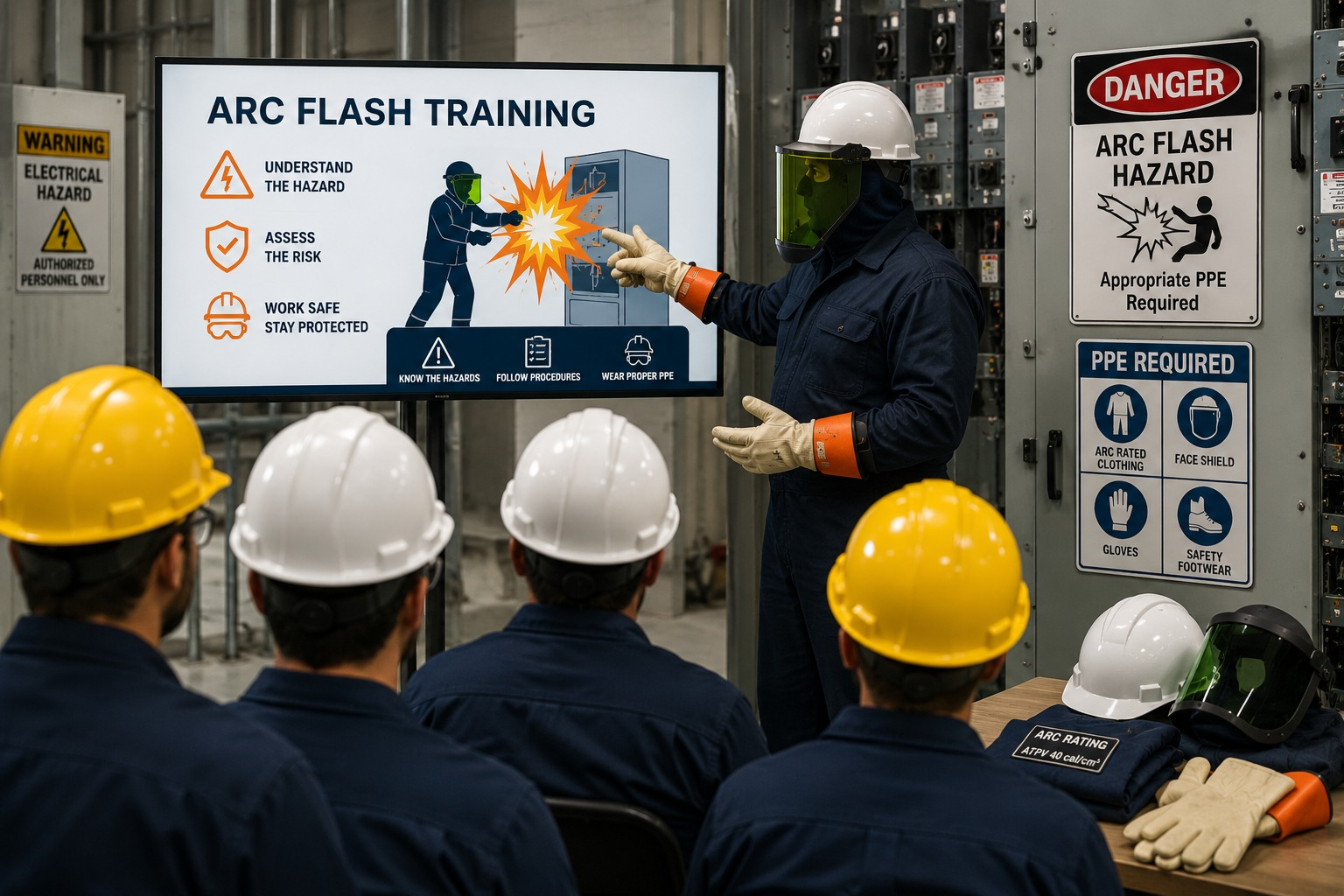
Effective arc flash training for electrical workers and safety professionals covers five core competencies:
- Hazard recognition: The ability to identify arc flash hazards in the workplace, recognising equipment types and operating conditions where arc flash risk is significant, understanding what approach boundaries mean in practice, and knowing when an energised electrical work permit is required before work may commence.
- Arc flash label interpretation: The ability to correctly read and apply the information on an arc flash warning label, including the incident energy value, working distance, arc flash boundary, and the minimum PPE arc rating required. Workers who cannot interpret arc flash labels cannot self-protect using the information the study provides.
- PPE selection and donning: The ability to select PPE appropriate to the calculated or assigned incident energy level, inspect PPE for damage and contamination before use, and don PPE correctly so that no skin or undergarment is exposed within the arc flash boundary. Incorrectly worn PPE is one of the most common contributing factors in arc flash injury investigations.
- Lockout/tagout (LOTO) and establishing an electrically safe work condition: The ability to follow the LOTO procedure for a specific piece of equipment and verify that an electrically safe work condition has been established before approaching within the restricted approach boundary. The safest arc flash protection is a de-energised system, LOTO is how that is achieved reliably.
- Energised electrical work permits: The ability to complete or review an energised electrical work permit, the documented justification, hazard analysis, and control specification required before any work is performed on live electrical equipment. Understanding why each element of the permit is required prevents the common tendency to treat the permit as an administrative hurdle rather than a safety tool.
HSEQ Professionals delivers comprehensive arc flash training through our 40-hour NFPA 70E Electrical Safety Specialist Course, covering all five competencies above across 13 structured modules. The course is specifically designed to prepare participants for CESCP, CESW, and CEST certification examination, and is available from our offices in Jeddah, Riyadh, Karachi, and Lahore, or online globally.
Arc Flash Hazard Analysis in Saudi Arabia: The Industrial Context
Saudi Arabia’s industrial and energy sector presents some of the most demanding electrical safety environments in the world. Aramco’s upstream and downstream facilities, SABIC’s petrochemical plants, the Royal Commission’s industrial cities at Jubail and Yanbu, and the expanding construction programmes of NEOM, Diriyah Gate, and the Red Sea Project all involve high-energy electrical distribution systems where arc flash incident energy levels can be significant and the consequences of inadequate arc flash protection are severe.
For organisations operating in Saudi Arabia, arc flash hazard analysis is increasingly expected, not only by OSHA-aligned safety management frameworks that international companies bring to the market, but by the Saudi Electricity Company’s technical standards, by Aramco’s contractor safety management system requirements, and by the growing body of Saudi safety professionals who understand that a label on a panel door is not an arc flash programme.
The practical challenges of arc flash management in the Saudi context include: the pace of new construction, which creates facilities where initial arc flash studies may be outdated before the facility is fully operational; the mix of international and local workforce with varying electrical safety backgrounds; and the bilingual (Arabic/English) operational environment, which requires arc flash warning labels and safety communications to be accessible to all workers.
HSEQ Professionals delivers arc flash training in Saudi Arabia from our offices in Jeddah and Riyadh in both English and Arabic ensuring that the competence the training builds is accessible to the full workforce, not only to English-speaking engineers.
Our NFPA 70E Electrical Safety Specialist Course covers arc flash hazard analysis in detail across Modules 02, 06, and 12, including the two NFPA 70E methods for determining PPE requirements, arc flash boundary calculations, and incident energy reduction methods. For organisations requiring a full arc flash hazard analysis conducted for their facilities in Saudi Arabia, our technical and auditing services team can assist.
Arc Flash Training and Analysis Support from HSEQ Professionals
HSEQ Professionals delivers expert arc flash training and NFPA 70E electrical safety programmes from offices in Jeddah, Riyadh, Karachi, and Lahore with bilingual English and Arabic delivery and online access for participants across the GCC. Our NFPA 70E Electrical Safety Specialist Course is a comprehensive 40-hour programme covering arc flash hazard analysis, PPE selection, LOTO, and energised work permits, preparing participants for CESCP, CESW, and CEST certification.
We also deliver a full range of NFPA electrical safety training courses and HSEQ occupational safety programmes for organisations across Saudi Arabia, the GCC, and Pakistan. Whether you need individual course enrolment, a group corporate booking, bilingual in-house delivery at your facility, or technical support for your arc flash hazard analysis programme, our team will design the right solution.
Contact our team to discuss arc flash training requirements, upcoming course dates in Saudi Arabia, or in-house delivery at your Riyadh or Jeddah facility.
Frequently Asked Questions
-
How often does an arc flash hazard analysis need to be updated?
NFPA 70E requires the arc flash hazard analysis to be reviewed and updated whenever changes are made to the electrical system that could affect the arc flash hazard, including modifications to equipment, changes to protective device settings, changes to the utility supply, or additions to the distribution system.
In the absence of such changes, NFPA 70E recommends reviewing the study at intervals not exceeding five years. Any significant electrical incident should also trigger an immediate review of the affected equipment’s arc flash assessment.
-
What is the difference between arc flash and electric shock?
Electric shock occurs when a worker becomes part of an electrical circuit, current passes through the body, causing internal burns, ventricular fibrillation, and potentially cardiac arrest. Arc flash is a different hazard, it does not require the worker to be part of the circuit. The intense radiant heat, pressure wave, and molten metal produced by an arc fault can cause severe burns, blast injuries, and death even when the worker has no direct contact with the energised conductor.
Both hazards are addressed by NFPA 70E, but they require different protective approaches, shock protection focuses on preventing contact; arc flash protection focuses on PPE and approach boundaries.
-
Can arc flash PPE be reused after an arc flash event?
No. Any arc-rated PPE that has been exposed to an actual arc flash event must be taken out of service immediately and must not be reused, regardless of whether it appears visually undamaged. The protective capability of arc-rated material is consumed during an arc flash exposure; the garment may look intact but its arc rating has been compromised. Damaged PPE must be disposed of in a way that prevents reuse and replacement before any further energised work takes place.
-
Is arc flash analysis required for low-voltage systems (below 240V)?
NFPA 70E applies to electrical systems operating at 50 volts or greater. For systems below 240V with available fault current below 2,000 amperes and where the circuit is protected by a standard overcurrent protective device, NFPA 70E provides a simplified approach. However, arc flash hazards can exist even at 208V in commercial and light industrial systems, particularly in large distribution panels with high available fault current.
The assumption that low-voltage systems do not present arc flash hazards is a common and dangerous error. A qualified person should always evaluate whether a simplified approach is appropriate before assuming that low-voltage equipment is exempt.
-
Who should receive arc flash training in our organisation?
All workers who may be exposed to electrical hazards should receive arc flash awareness training, including maintenance personnel, facilities staff, and anyone who accesses electrical panels or distribution equipment, even for routine tasks such as resetting breakers or reading meters.
Workers who perform hands-on electrical tasks on or near energised equipment require comprehensive arc flash training covering NFPA 70E requirements, arc flash hazard analysis interpretation, PPE selection, and LOTO procedures. Safety managers, electrical engineers, and HSEQ professionals responsible for the electrical safety programme require training at the level of the full NFPA 70E standard, which our Electrical Safety Specialist Course provides.