
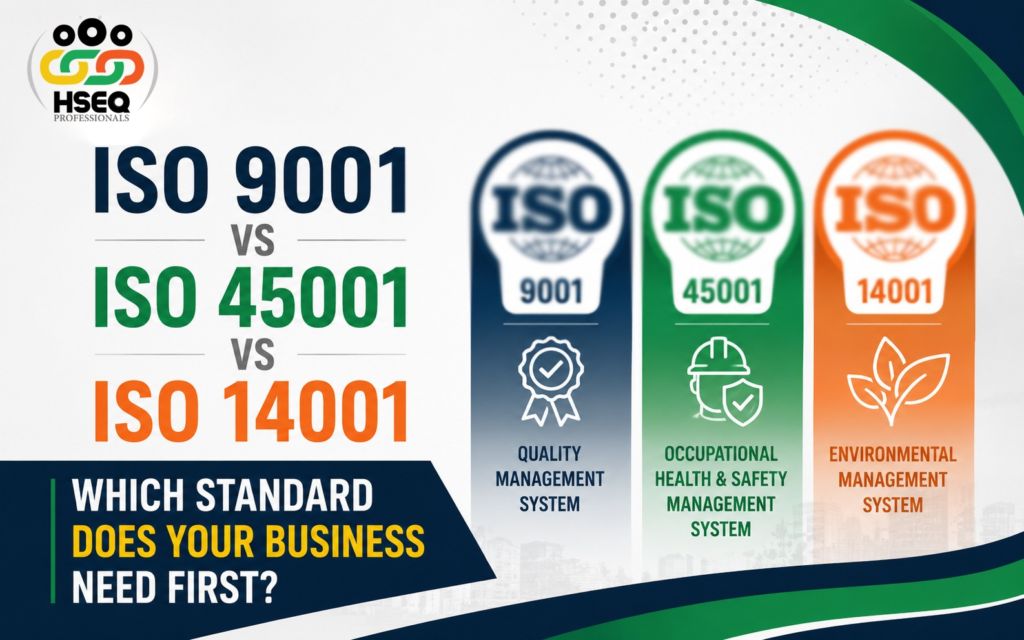
ISO 9001 vs ISO 45001 vs ISO 14001: Which Standard Does Your Business Need First?
Every week, organisations across Saudi Arabia face the same decision. They know they need ISO certification, a client has asked for it, a tender requires it, or a senior manager has returned from a conference convinced it is time. The question is not whether to pursue ISO. The question is where to start.
ISO 9001, ISO 45001, and ISO 14001 are the three most in-demand ISO management system standards in Saudi Arabia and the wider GCC. Together, they form the QHSE triplet: Quality, Health & Safety, and Environment, that underpins contractor prequalification for Vision 2030 projects, Aramco and SABIC vendor registration, Etimad Platform tender scoring, and most serious procurement frameworks in the Kingdom. But they are not interchangeable, they do not serve the same purpose, and the right starting point depends entirely on what your business does, who your clients are, and what your most pressing compliance obligation is.
This guide provides a direct ISO standards comparison of all three, explains which to prioritise by sector, and answers the question that every Saudi business eventually asks: when should we pursue all three together as an Integrated Management System (IMS) rather than one at a time?
The Short Answer: Which ISO Standard to Get First in Saudi Arabia
For most Saudi businesses, the starting point is determined by the most immediate commercial pressure:
- If you are pursuing government tenders on the Etimad Platform: Start with ISO 9001. Quality management is the directly weighted criterion on the platform’s technical scoring system.
- If you are a contractor or supplier to Aramco, SABIC, NEOM, or any major giga-project: Start with ISO 45001. HSEQ prequalification is the first gate, without it, you cannot register as a vendor regardless of how strong your quality or environmental credentials are.
- If your primary compliance obligation is environmental, NEOM ESG reporting, environmental permit conditions, SFDA for food, or SEC industrial licensing: Start with ISO 14001.
- If you are an IT, fintech, or healthcare organisation handling personal data under Saudi Arabia’s PDPL: Start with ISO 27001, information security is the most pressing regulatory requirement for your sector.
ISO 9001 vs ISO 45001 vs ISO 14001: Side-by-Side Comparison
The three standards share the same High-Level Structure (Annex SL), a ten-clause architecture that ISO adopted to make management system standards compatible and integrable. Despite this shared structure, each standard addresses a fundamentally different aspect of how an organisation operates:
|
ISO 9001:2015 Quality Management |
ISO 14001:2015 Environmental Management |
ISO 45001:2018 Occupational Health & Safety |
|
|
Focus |
Product and service quality, meeting customer requirements consistently | Environmental impact, reducing pollution, waste, and resource consumption |
Worker health and safety, preventing workplace injuries and occupational illness |
|
Primary beneficiary |
Customers, clients, and procurement authorities | Environment, regulators, communities, and investors |
Workers, contractors, and visitors on site |
|
Core requirement |
Risk-based quality planning, process control, customer satisfaction measurement | Environmental aspects register, legal compliance, objectives and targets |
Hazard identification, risk assessment, operational controls, worker participation |
|
PDCA cycle application |
Plan quality processes → Do → Check outputs → Act on nonconformities | Plan environmental controls → Do → Monitor environmental performance → Act on exceedances |
Plan hazard controls → Do → Monitor incident rates and OH&S performance → Act on findings |
|
Typical Saudi drivers |
Etimad Platform scoring, government tender prequalification, client quality assurance requirements | Vision 2030 ESG obligations, environmental permit compliance, NEOM sustainability requirements |
Aramco contractor HSE prequalification, NEOM project safety requirements, OSHA-aligned frameworks |
|
Certification body |
Accredited third-party certification body (e.g. PECB partner) | Accredited third-party certification body (e.g. PECB partner) |
Accredited third-party certification body (e.g. PECB partner) |
|
Certification validity |
3 years, annual surveillance audits required | 3 years, annual surveillance audits required |
3 years, annual surveillance audits required |
|
Integration potential |
Integrates directly with ISO 14001 and ISO 45001 via shared High-Level Structure (Annex SL) | Integrates directly with ISO 9001 and ISO 45001 via shared High-Level Structure (Annex SL) |
Integrates directly with ISO 9001 and ISO 14001 via shared High-Level Structure (Annex SL) |
ISO 9001: Quality Management System – What It Covers and When to Prioritise It
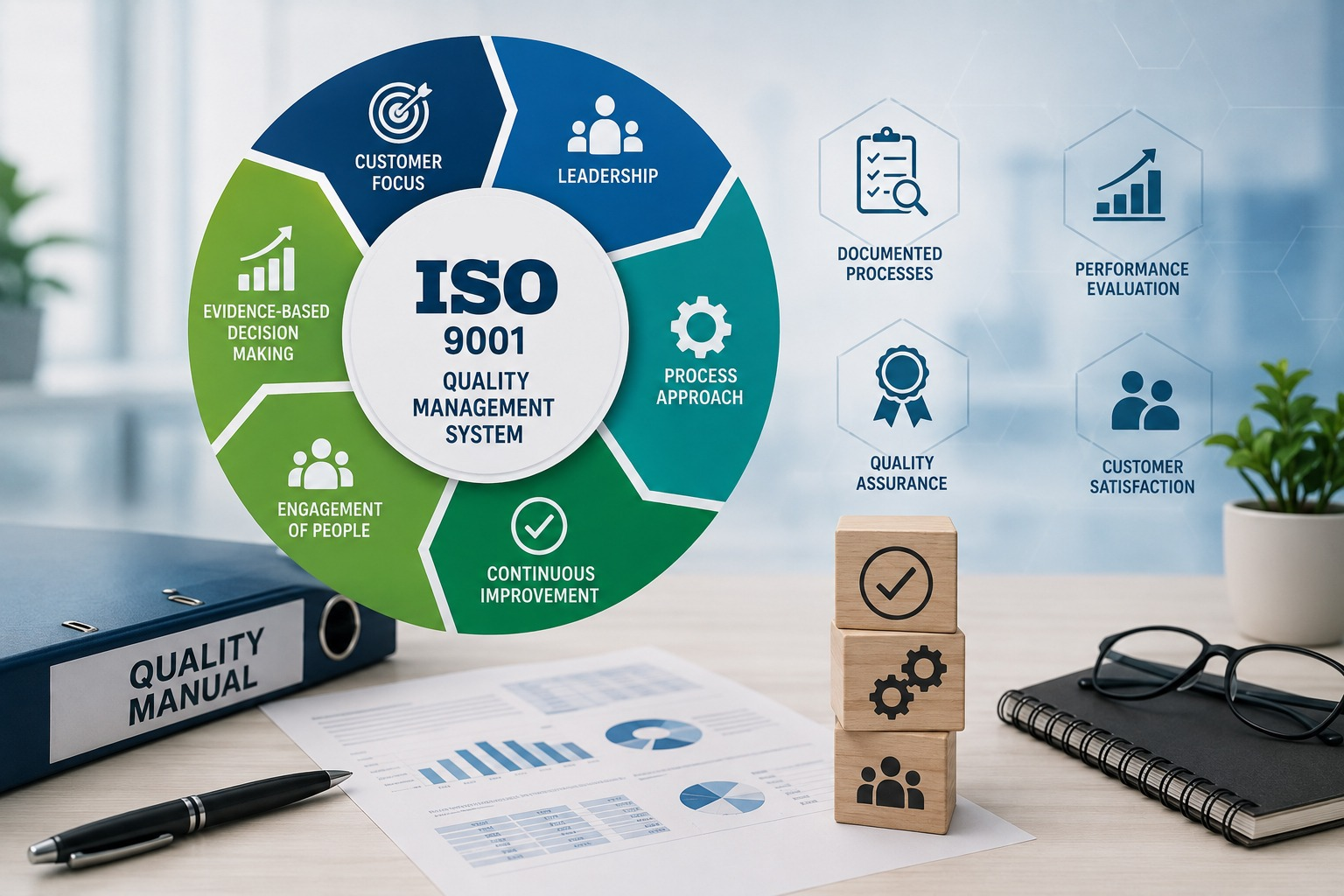
ISO 9001:2015 is the world’s most widely adopted management system standard, with over one million certifications active globally. It provides a framework for ensuring that an organisation consistently delivers products and services that meet customer and regulatory requirements, and that it systematically identifies and acts on opportunities to improve.
In Saudi Arabia, ISO 9001 sits at the intersection of two powerful commercial forces. The first is the Etimad Platform, the Saudi government’s unified procurement portal, through which virtually all government contracts are managed. ISO 9001 certification directly improves an organisation’s technical score on Etimad, increasing its competitiveness for government tenders across every ministry and government entity.
The second is the general expectation of Saudi and international private sector clients that suppliers maintain a documented quality management system. As Saudi Arabia integrates more deeply into global supply chains under Vision 2030, ISO 9001 has become the baseline expectation in most B2B commercial relationships.
What ISO 9001 requires in practice
- Context and leadership: Understanding internal and external factors affecting quality, defining the scope of the QMS, and establishing clear quality objectives with management commitment.
- Customer focus and planning: Systematically capturing customer requirements, translating them into process inputs, and planning how to consistently meet them.
- Process control: Documenting and controlling the processes that directly affect product or service quality, from design and procurement through to delivery and after-service.
- Performance monitoring: Measuring customer satisfaction, internal audit performance, and process KPIs and using that data to drive improvement decisions.
- Nonconformity management: Identifying quality failures, investigating root causes, implementing corrective actions, and verifying their effectiveness.
The ISO 9001 Lead Auditor and Lead Implementer training is available through HSEQ Professionals’ ISO Lead Auditor Courses for organisations building internal audit capability alongside their certification journey.
ISO 45001: Occupational Health & Safety – What It Covers and When to Prioritise It
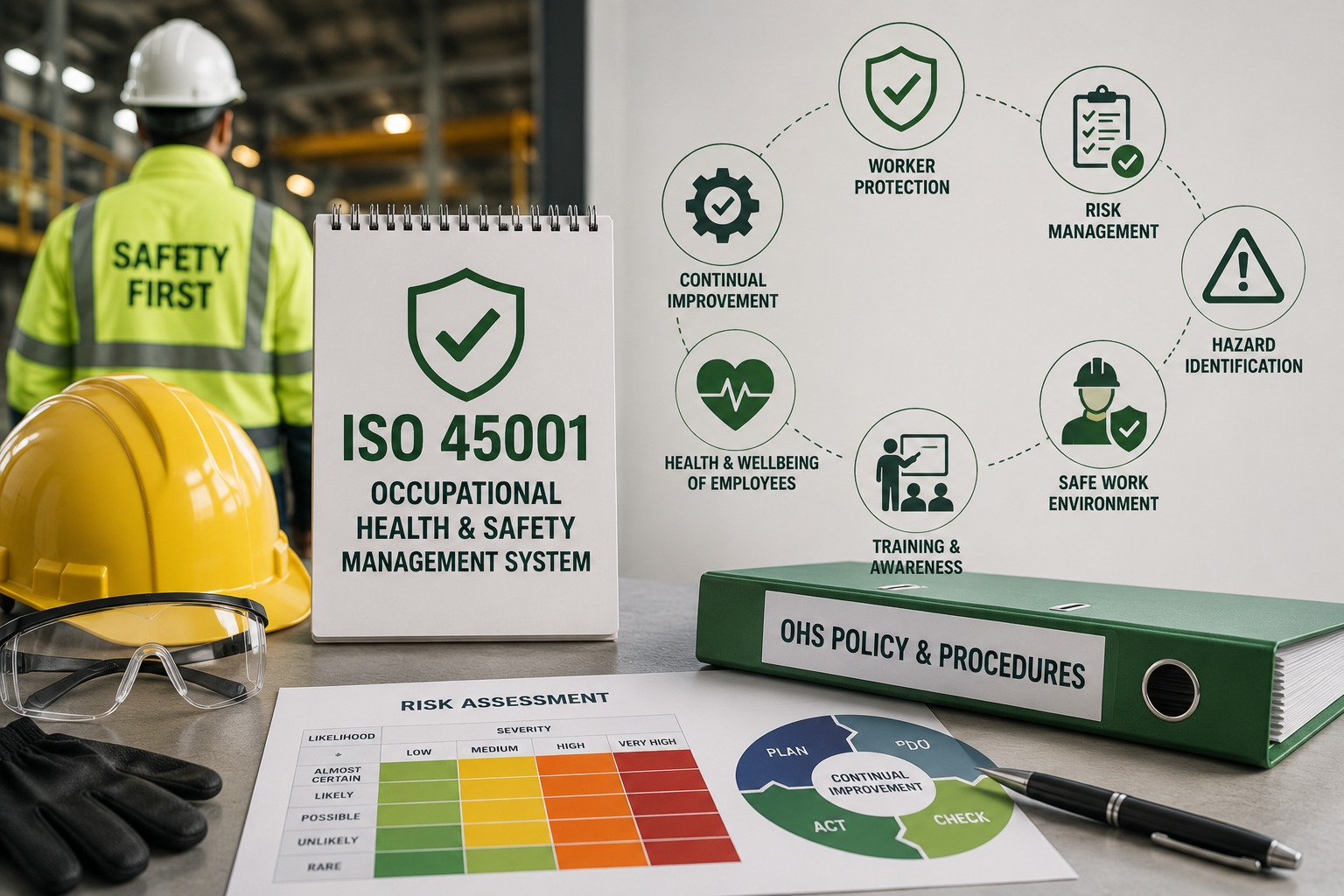
ISO 45001:2018 is the international standard for Occupational Health and Safety Management Systems (OHSMS). It replaced OHSAS 18001 in 2021 and is now the definitive global framework for protecting workers from occupational injury and illness, covering hazard identification, risk assessment, operational controls, worker participation, and emergency preparedness.
In Saudi Arabia, ISO 45001 is the single most demanded ISO standard in terms of training and certification volumes. The reason is straightforward: it is required before almost anything else. Aramco’s contractor HSEQ prequalification, SABIC’s supplier registration, and the HSE requirements built into every major Vision 2030 project contract, NEOM, The Line, Diriyah Gate, the Red Sea Project, all require suppliers and contractors to demonstrate a structured, certified occupational health and safety management system. Without ISO 45001, you cannot bid for the work that Vision 2030 is generating.
What ISO 45001 requires in practice
- Hazard identification and risk assessment: A systematic register of all workplace hazards, assessed for likelihood and severity, with documented controls applied in accordance with the hierarchy of controls.
- Worker participation (Clause 5.4): A structured mechanism for consulting workers in hazard identification and OH&S decision-making. This requirement distinguishes ISO 45001 from its predecessor OHSAS 18001 and is specifically tested by certification auditors.
- Operational controls: Documented procedures, permits to work, contractor management, and change management controls that prevent or mitigate the hazards in the risk register.
- Emergency preparedness and response: Defined, tested emergency response procedures covering the scenarios relevant to the organisation’s operations.
- Incident investigation: A systematic process for investigating incidents and near misses, determining root causes, and verifying that corrective actions prevent recurrence.
For a full walkthrough of the ISO 45001 implementation process, see our guide: ISO 45001 Implementation Guide: Step-by-Step for Occupational Health & Safety.
ISO 14001: Environmental Management System – What It Covers and When to Prioritise It
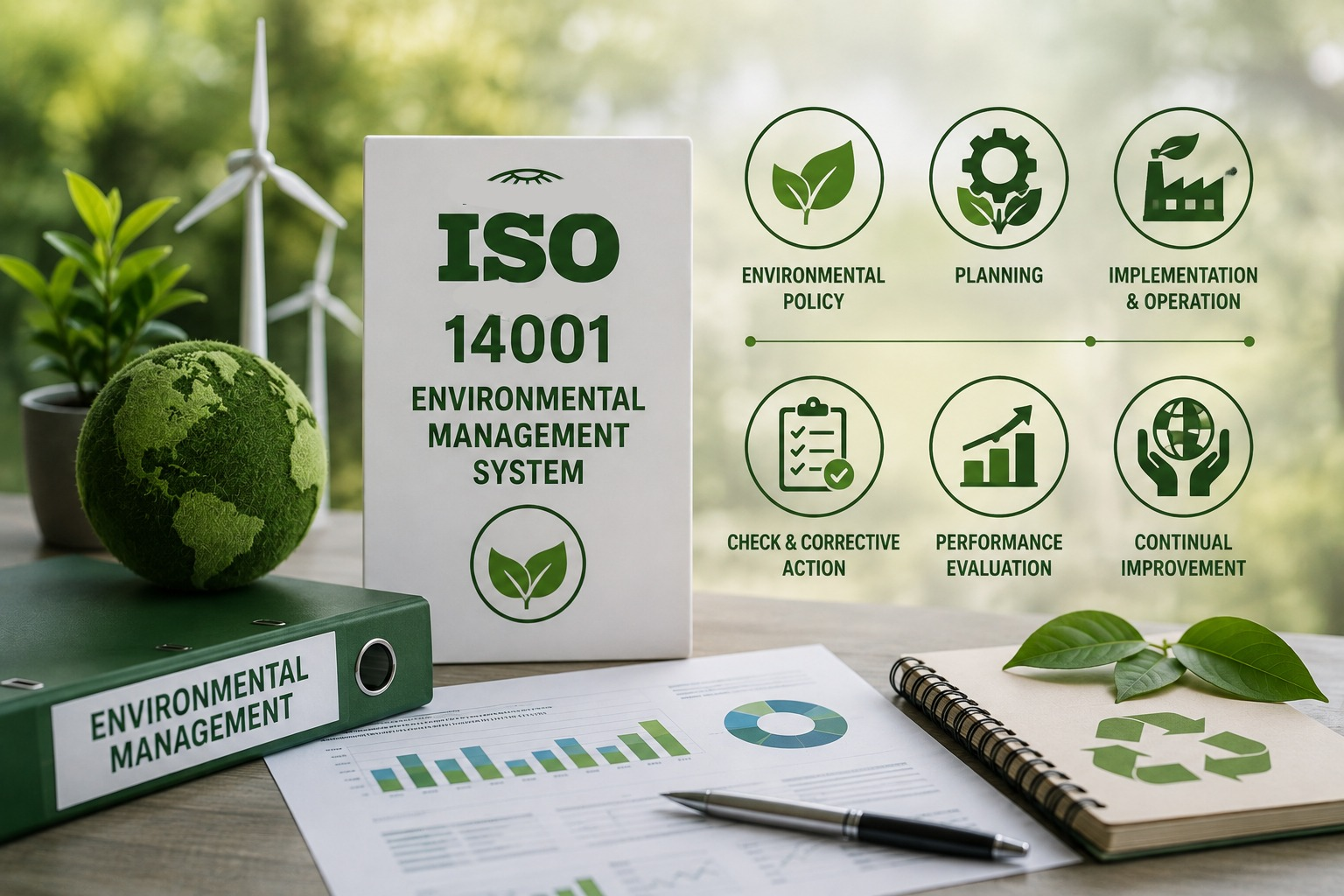
ISO 14001:2015 is the international standard for Environmental Management Systems (EMS). It provides a framework for identifying the environmental aspects of an organisation’s activities, assessing their significance, and implementing systematic controls to reduce negative environmental impact from carbon emissions and energy consumption to waste management, water use, and chemical handling.
In Saudi Arabia, ISO 14001 demand is growing rapidly, driven by three parallel forces. The first is Vision 2030’s sustainability agenda, Saudi Arabia’s net-zero commitment to 2060 and the National Environmental Strategy have raised environmental compliance expectations across the private sector.
The second is the ESG reporting requirements of international investors, banks, and project finance institutions funding Vision 2030 projects, ISO 14001 certification is a recognised ESG credential. The third is the environmental permit and regulatory compliance framework administered by the National Centre for Environmental Compliance (NCEC), which increasingly references ISO 14001-aligned practices in its inspection criteria.
What ISO 14001 requires in practice
- Environmental aspects register: A comprehensive identification of all activities, products, and services that interact with the environment and a determination of which aspects are significant based on their actual or potential environmental impact.
- Legal compliance register: Identification and ongoing tracking of all applicable environmental legislation, regulations, and permits, including NCEC requirements, municipal regulations, and industry-specific environmental standards.
- Environmental objectives and targets: Measurable environmental improvement goals with assigned owners, timelines, and monitoring plans, linked to the most significant environmental aspects.
- Operational controls: Documented procedures for managing significant environmental aspects, waste segregation, chemical storage, emissions controls, energy management, and contractor environmental requirements.
- Emergency preparedness: Response plans for environmental emergencies, chemical spills, waste incidents, or equipment failures that could cause significant environmental impact.
ISO 9001 vs ISO 45001: The Key Differences
The most common ISO 9001 vs ISO 45001 question comes from organisations that need both but are deciding which to implement first. The two standards address completely different stakeholders and risks:
- ISO 9001 protects customers – it ensures that products and services consistently meet requirements. Its primary measurement is customer satisfaction and nonconforming outputs.
- ISO 45001 protects workers – it ensures that people go home safely. Its primary measurement is injury and illness rates, hazard control effectiveness, and worker participation.
- ISO 9001 is commercially driven – clients and procurement authorities demand it as a quality assurance signal.
- ISO 45001 is both commercially and ethically driven – it is required by clients, but it also reflects an organisation’s genuine commitment to the people it employs.
- In the Saudi context, ISO 45001 almost always comes first – because contractor HSE prequalification is the first commercial gate. ISO 9001 then follows as the second layer of the qualification package.
ISO 45001 vs ISO 14001: Understanding the Relationship
The ISO 45001 vs ISO 14001 comparison is relevant for organisations pursuing both — which in the Saudi context typically means any construction, industrial, or energy sector business targeting Vision 2030 project work. The two standards have significant structural overlap under Annex SL but address different operational domains:
- ISO 45001 focuses inward – the hazards, risks, and protective measures that apply to the people doing the work inside the facility or on the project site.
- ISO 14001 focuses outward – the impacts that the organisation’s activities have on the surrounding environment, and the controls that limit those impacts.
- Both require hazard/aspect identification, risk assessment, operational controls, and emergency preparedness – but for different hazard categories. This is why they integrate so efficiently under a single IMS.
- ISO 45001 is typically the higher commercial priority – an injured worker is an immediate liability; an environmental impact may take longer to manifest as a commercial or regulatory consequence. This does not make environmental management less important, it reflects the immediacy of the compliance driver in most procurement contexts.
Which ISO Standard to Get First: Decision Guide by Industry Sector
The right starting point for QHSE certification in Saudi Arabia depends on your sector, your customer base, and your most pressing compliance obligation. The table below maps the recommended certification sequence for the most common Saudi industry sectors:
|
Industry sector |
Start with | Add next |
Complete QHSE triplet |
| Construction & infrastructure (including Vision 2030 giga-projects) | ISO 45001 – contractor prequalification and site safety are the first gate to pass | ISO 9001 – project quality management for tender scoring and client assurance |
ISO 14001 – environmental compliance for ESG-aligned project delivery |
|
Oil, gas & petrochemicals (Aramco, SABIC, SATORP) |
ISO 45001 – Aramco contractor HSE prequalification is non-negotiable | ISO 14001 – environmental permit compliance and SEC regulatory requirements |
ISO 9001 – quality system certification for supplier registration programs |
|
Manufacturing & industrial |
ISO 9001 – product quality consistency and export market access requirements | ISO 45001 – workforce safety and incident reduction across production environments |
ISO 14001 – waste, emissions, and resource efficiency as ESG reporting grows |
|
Food & beverage (SFDA regulated) |
ISO 22000 – food safety is the primary regulatory requirement (SFDA compliance) | ISO 9001 – quality management for supply chain and retailer audit requirements |
ISO 45001 – workforce safety in production and processing environments |
|
IT, fintech & digital services |
ISO/IEC 27001 – information security is the primary driver (NCA, PDPL, SAMA) | ISO 9001 – service quality and client assurance requirements |
ISO 27701 – privacy information management extension to ISO 27001 for PDPL alignment |
|
Government suppliers & professional services |
ISO 9001 – Etimad Platform scoring and government tender requirements | ISO 45001 – workplace safety obligations for facility and operational staff |
ISO 14001 – environmental obligations for facilities management and government contracts |
|
Healthcare & pharma |
ISO 45001 – worker safety in clinical and laboratory environments | ISO 9001 – service quality and accreditation requirements |
ISO 14001 – medical waste and chemical disposal regulatory compliance |
|
Logistics & transportation |
ISO 9001 – service quality for international shipping and customs requirements | ISO 45001 – driver and warehouse worker safety compliance |
ISO 39001 – road traffic safety management, increasingly expected by Saudi clients |
Should You Pursue All Three Together? The Case for an Integrated Management System
Once an organisation has decided that it needs ISO 9001, ISO 14001, and ISO 45001, the next strategic question is whether to pursue them sequentially, one at a time, over several years, or simultaneously as an Integrated Management System (IMS). In the Saudi context, the answer for most organisations is increasingly: pursue them together.
The reason is structural. Because ISO 9001, ISO 14001, and ISO 45001 all share the same ten-clause High-Level Structure, a large proportion of the documentation, processes, and audit activities that the combined system requires can be designed once and applied across all three standards simultaneously. Building them separately means building much of that shared infrastructure three times.
| Separate systems (3 standards independently) | Integrated Management System (IMS) |
Benefit of integration |
|
3 separate document sets, 3 separate manuals, 3 policy documents |
1 unified IMS manual, 1 policy covering all three standards |
Significant reduction in documentation burden, time and resource saving |
|
3 internal audit programmes, separate auditors, separate schedules |
1 combined audit programme covering all three standards simultaneously |
Fewer audit days, less disruption, lower cost |
|
3 management reviews, often on different dates with different attendees |
1 integrated management review covering QHSE performance in a single session |
Leadership gets a complete picture, quality, safety, and environment together |
|
Risk of conflicting objectives (a quality target that creates an environmental problem) |
Integrated objectives aligned across all three disciplines from the outset |
No cross-discipline conflicts, all objectives point in the same direction |
|
3 separate certification audits, 3 bodies, 3 audit fees, 3 preparation cycles |
1 combined third-party certification audit covering all three standards |
Lower certification cost, single audit preparation, simpler ongoing surveillance |
For organisations where the immediate priority is a single certification, typically ISO 45001 for a specific tender or prequalification, HSEQ Professionals recommends designing the documentation architecture with IMS integration in mind from the outset, even when seeking certification for only one standard initially. This dramatically reduces the cost and time of adding the second and third standards later.
For a full guide to IMS planning and implementation, see our blog: ISO Integrated Management Systems: Benefits, Challenges & Best Practices.
HSEQ Professionals delivers combined IMS consulting and training across all three standards from offices in Jeddah, Riyadh, Karachi, and Lahore. Our ISO management systems consulting service covers gap assessment, documentation design, and certification audit preparation for single-standard and integrated programmes.
Why All Three Standards Work Together: The High-Level Structure Explained
The reason ISO 9001, ISO 14001, and ISO 45001 can be integrated so effectively is ISO’s Annex SL, the High-Level Structure that all three standards share. Annex SL gives every major ISO management system standard the same ten-clause architecture, the same definitions for common terms, and the same Plan-Do-Check-Act (PDCA) logic at the core of every requirement.
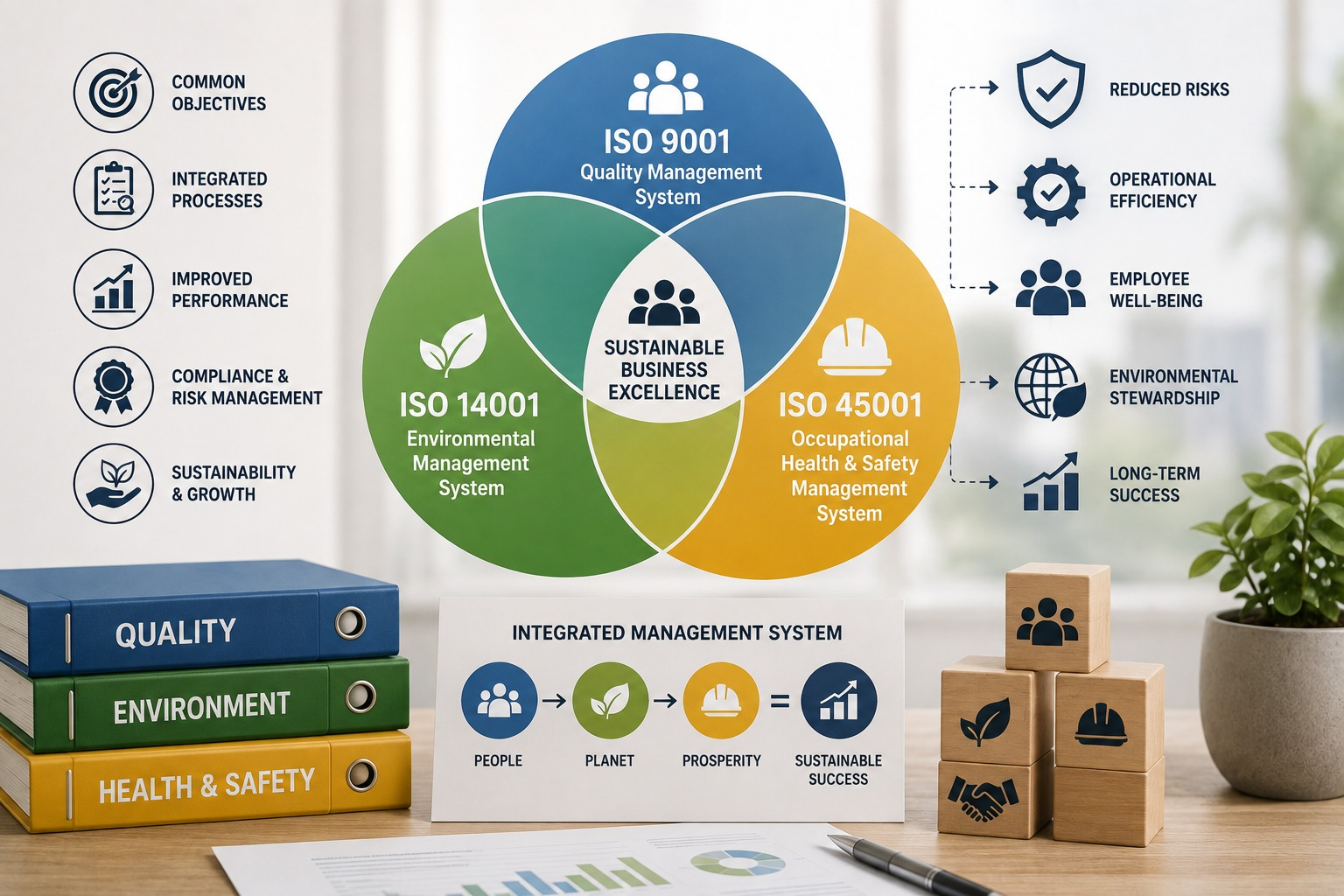
In practical terms, this means:
- One context analysis (Clause 4) can identify internal and external issues relevant to quality, environment, and safety simultaneously, one exercise, three standards satisfied.
- One leadership review (Clause 5) can establish policies, assign responsibilities, and demonstrate commitment across all three disciplines in a single document set.
- One internal audit programme (Clause 9.2) can be structured to cover all three standards in each audit cycle, fewer audit days, less disruption, lower cost than three separate programmes.
- One management review (Clause 9.3) can evaluate quality, environmental, and safety performance together, giving leadership a complete QHSE picture rather than three partial views.
Where the standards diverge, ISO 45001’s worker participation requirement (Clause 5.4), ISO 14001’s environmental aspects register (Clause 6.1.2), and ISO 9001’s customer focus requirements (Clause 5.1.2), the IMS simply adds standard-specific modules to the shared framework. The duplication is eliminated; the standard-specific depth is preserved.
Start Your ISO Certification Journey with HSEQ Professionals
Whether you are pursuing a single ISO certification to meet an immediate prequalification requirement, or planning a full QHSE Integrated Management System for long-term competitive advantage, HSEQ Professionals has the consulting expertise, training capability, and regional knowledge to support you at every stage. We work with organisations across Saudi Arabia, the GCC, and Pakistan.
Explore our full ISO standards training catalogue, or contact our team to discuss your certification requirements, get a gap assessment, and design the right implementation roadmap for your organisation.
Frequently Asked Questions
-
Can we certify to all three ISO standards at the same time?
Yes. A combined third-party certification audit can assess an Integrated Management System against ISO 9001, ISO 14001, and ISO 45001 simultaneously, with a single audit team, a single audit schedule, and a single set of certificates issued upon successful completion. Many certification bodies offer combined audits at a lower total cost than three separate audits.
HSEQ Professionals supports organisations through combined certification audit preparation as part of our ISO management systems consulting service.
-
How long does it take to achieve ISO 9001, ISO 14001, and ISO 45001 together?
For organisations building an IMS from scratch, the timeline to combined certification typically ranges from 6 to 15 months depending on the size of the organisation, the number of sites in scope, and the maturity of existing management system practices. Organisations with existing quality, safety, or environmental management frameworks in place can often achieve combined certification faster, particularly if their existing documentation already reflects some of the shared requirements of all three standards. HSEQ Professionals will conduct a gap assessment at the outset to give a realistic, project-specific timeline.
-
Is QHSE certification required for all Vision 2030 project suppliers?
Not universally but practically, yes. ISO 45001 is explicitly required for health and safety prequalification on virtually every major Vision 2030 project. ISO 9001 and ISO 14001 are required for full QHSE contractor prequalification on the larger programmes (NEOM, Diriyah Gate, Red Sea Project).
-
Which standard is cheapest to implement first?
ISO 9001 is typically the fastest and lowest-cost single standard to implement, because many businesses already have informal quality management practices in place that can be formalised and documented. ISO 14001 and ISO 45001 require more extensive operational assessment, the environmental aspects register and the hazard identification process are both significant undertakings that require operational data and worker involvement.
-
Where can we get ISO training in Saudi Arabia?
HSEQ Professionals delivers ISO standards training courses in Saudi Arabia from offices in Jeddah and Riyadh, covering ISO 9001, ISO 14001, ISO 45001, and a full range of other ISO management system standards. All courses are available in both English and Arabic, with online options for participants across the GCC. In-house corporate training at your facility in Riyadh, Jeddah, or elsewhere in the Kingdom can be arranged for groups.