
ISO Integrated Management Systems (IMS): Benefits, Challenges & Best Practices
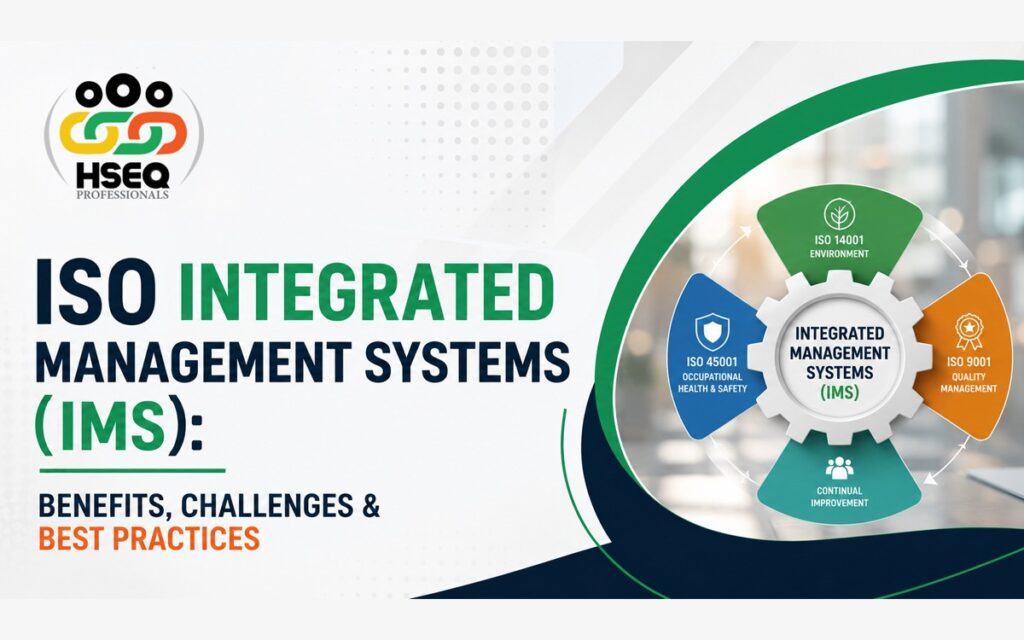
Most organisations that pursue ISO certification do so one standard at a time: ISO 9001 for quality, then ISO 14001 for environmental management, then ISO 45001 for occupational health and safety. The result is often three separate systems, three separate sets of documentation, three internal audit programmes, and three management reviews running in parallel. The overhead is real, and the duplication is unnecessary.
An Integrated Management System (IMS) solves this. By combining the requirements of multiple ISO standards into a single, coherent framework, organisations eliminate duplication, reduce audit fatigue, and build a management system that actually reflects how the business operates, rather than how three different standards were written. This guide explains what an integrated management system is, how it works in practice, and what it takes to do it well.
What Is an Integrated Management System?
An integrated management system is a single management framework that combines the requirements, processes, documentation, and audit activities of two or more ISO standards. Rather than maintaining separate silos for quality, environmental, and safety management, an IMS aligns them around a common structure, shared policies, unified objectives, consolidated documentation, and a single internal audit programme that covers all standards at once.
The concept is made possible by the High-Level Structure (HLS), also known as Annex SL, which ISO introduced to give all major management system standards the same ten-clause architecture. ISO 9001:2015, ISO 14001:2015, and ISO 45001:2018 all share the same clause structure, the same Plan-Do-Check-Act (PDCA) logic, and many of the same core requirements. This shared backbone is what makes meaningful integration possible rather than just a document-filing exercise.
The most common combinations are:
- QMS + EMS: ISO 9001 and ISO 14001, quality and environmental management.
- QMS + OHSMS: ISO 9001 and ISO 45001, quality and occupational health and safety.
- QHSE: ISO 9001, ISO 14001, and ISO 45001, quality, health, safety, and environment in a single IMS. The most widely adopted configuration across manufacturing, oil and gas, and construction.
Why Integrated Management Systems Meaning Matters in Practice
Understanding the integrated management systems meaning goes beyond knowing the definition. The real question is what integration delivers operationally. Here is how an IMS changes day-to-day management for organisations that implement it properly.
|
Benefits of an IMS |
Challenges to anticipate |
|
Single audit programme covering all standards, fewer auditor days, less disruption |
Initial alignment of existing separate systems takes time and resource investment |
|
One management review covering quality, environmental, and safety performance together |
Staff may resist change if they own a specific system and see integration as a threat |
|
Shared documentation, one procedure can satisfy requirements across multiple standards |
Requires top management to genuinely sponsor the integration, not just approve it |
|
Reduced risk of conflicting objectives (e.g. a quality target that creates an environmental problem) |
Identifying common vs. standard-specific requirements demands experienced IMS knowledge |
|
Stronger evidence of strategic alignment for clients, investors, and certification bodies |
Certification bodies must audit all integrated standards simultaneously, requires preparation |
| Lower long-term compliance costs as the organisation scales to new standards or sites |
Poorly designed IMS can become over-complex if integration is forced rather than logical |
How the High-Level Structure Enables ISO Management Systems Integration
The practical engine of any IMS is the High-Level Structure. Because ISO 9001, ISO 14001, and ISO 45001 all share the same clause framework, context (Clause 4), leadership (Clause 5), planning (Clause 6), support (Clause 7), operation (Clause 8), performance evaluation (Clause 9), and improvement (Clause 10), large portions of the system can be written once and applied across all standards.
A single Context of the Organisation exercise (Clause 4) can identify internal and external issues relevant to quality, environment, and safety simultaneously. A single Management Review (Clause 9.3) can assess performance data from all three disciplines in one meeting. A single Internal Audit Programme (Clause 9.2) can be structured to cover all applicable standards in each audit cycle.
Where standards diverge, for example, ISO 45001’s specific requirements for worker consultation (Clause 5.4) or ISO 14001’s environmental aspects register (Clause 6.1.2), the IMS simply adds standard-specific modules to the shared framework rather than duplicating the whole structure.
How to Build an Integrated Management System: Best Practices
1. Start with a gap and alignment assessment
Before designing your IMS, map what you currently have. Identify which requirements from each standard are already satisfied, which are partially in place, and which are absent entirely. Then compare the clause-by-clause requirements of your target standards to identify which can be genuinely shared and which are standard-specific. This mapping exercise is the foundation of a well-designed IMS, skipping it leads to superficial integration that fails certification audits.
HSEQ Professionals carries out structured alignment assessments as part of our ISO management systems consulting service, producing a clause mapping document and a phased integration roadmap tailored to your organisation.
2. Design your documentation architecture before writing a single procedure
One of the most common IMS mistakes is jumping straight into writing procedures without first designing the document hierarchy. A well-structured IMS typically has three tiers:
- Tier 1 – IMS Manual / Policy: High-level statement of scope, context, and commitments across all standards.
- Tier 2 – Procedures: How the organisation manages core processes. Shared procedures cover requirements common to multiple standards; standard-specific procedures cover requirements unique to one.
- Tier 3 – Work instructions and records: Operational-level documents and evidence of performance.
Document each procedure once. Reference it from multiple standards. Never write three separate procedures for what is essentially the same process with slightly different language.
3. Train your team on the integrated system – not just individual standards
Staff awareness and competence (Clause 7) must reflect the IMS as built, not three separate training programmes running in isolation. Team members need to understand how quality, environmental, and safety requirements interact in their specific roles, not just their own silo.
Formal ISO standard training courses covering the requirements of each standard provide the technical foundation. For those responsible for internal audits, ISO Lead Auditor courses that cover combined auditing techniques, auditing multiple standards in a single visit, are worth prioritising early in the implementation.
4. Build a combined internal audit programme
A combined audit programme is one of the clearest benefits of a working IMS — and one of the hardest things to get right. Auditors need to be competent across all standards in scope, or the team must include lead auditors qualified in each discipline. Audit plans must be structured to sample evidence against all applicable clause requirements in each cycle without creating an unmanageable workload.
Our technical and auditing services team supports organisations in designing and running combined internal audit programmes, including providing qualified auditors where internal capability gaps exist.
5. Run a single integrated management review
The management review is where an IMS either demonstrates its value or exposes its weaknesses. A well-run integrated management review covers performance data from quality, environmental, and safety objectives in a single session, allowing leadership to spot conflicts, trade-offs, and synergies that would be invisible if the reviews were held separately.
Prepare a consolidated performance pack in advance: customer satisfaction and quality KPIs, environmental monitoring data, OH&S incident and near-miss statistics, internal audit findings across all standards, and status of objectives. The review output, documented decisions and actions, should reflect the integrated nature of the system.
Common Integrated Management System Mistakes to Avoid
- Integrating at the document level only, creating a single folder structure without genuinely aligning processes and objectives.
- Keeping separate management reviews for each standard, this defeats the purpose of integration and leaves leadership with a fragmented view of performance.
- Assigning ownership of the IMS to one department (e.g. Quality) while safety and environment remain separate, integration requires cross-functional governance.
- Adding new standards to an existing IMS without revisiting the document architecture, patchwork integration creates inconsistency that auditors will identify.
- Treating certification as the end goal rather than the measure of a working system, the real value of an IMS is operational, not certificatory.
How Long Does IMS Implementation Take?
For organisations starting from existing separate management systems, integrating ISO 9001, ISO 14001, and ISO 45001 into a coherent IMS typically takes three to six months. For organisations building their first formal management system across all three standards simultaneously, the timeline extends to nine to fifteen months depending on size, sector, and the number of sites in scope.
Organisations that have already achieved individual certifications under the HLS-aligned versions of the standards (ISO 9001:2015, ISO 14001:2015, ISO 45001:2018) have a significant advantage, the shared clause structure means the integration work is primarily architectural and procedural rather than starting from scratch.
Build Your IMS with HSEQ Professionals
HSEQ Professionals has guided organisations across Saudi Arabia, Pakistan, and the USA through the full IMS journey, from alignment assessments and documentation design to combined internal audits and multi-standard certification. Our consultants hold lead auditor qualifications across ISO 9001, ISO 14001, and ISO 45001, giving you access to a team that understands integration from both the design and the audit perspective.
Contact our team to discuss your IMS project, or explore our full range of ISO management systems consulting and ISO training courses to find the right starting point for your organisation.