
What Is an HSEQ System? Definition, Components, and How It Works
If you work in construction, oil and gas, manufacturing, or any other industrial sector, you have almost certainly encountered the acronym HSEQ. It appears in job titles, contractor prequalification documents, company policies, and tender requirements. But for an acronym used this widely, it is surprisingly often left undefined.
This guide answers the question directly. What is HSEQ, what does it stand for, how does an HSEQ system actually work, and why does it matter for your organisation?
What Does HSEQ Stand For?
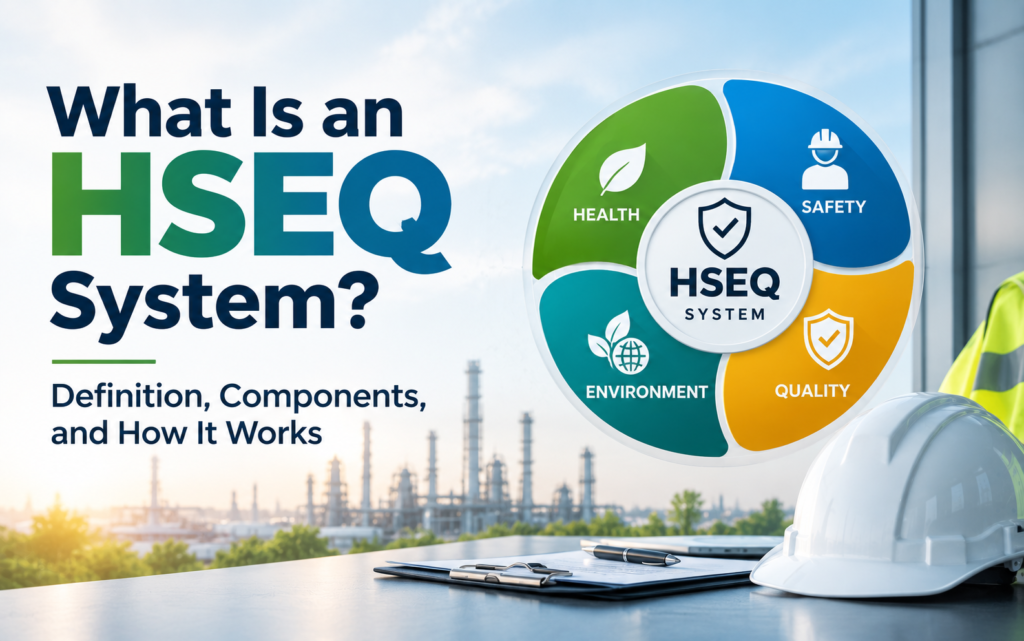
HSEQ stands for Health, Safety, Environment, and Quality. It is a management framework that addresses four interconnected disciplines, worker health, workplace safety, environmental impact, and product or service quality, all within a single, integrated system.
Each letter corresponds to a distinct but related operational concern, and in most organisations, a distinct ISO management standard:
|
H – Health |
S – Safety |
E – Environment |
Q – Quality |
|
Occupational health – physical and mental wellbeing of all workers, contractors, and visitors |
Prevention of accidents, injuries, dangerous occurrences, and near misses |
Management of environmental impacts – emissions, waste, water, energy, and chemical use |
Consistent delivery of products and services that meet customer and regulatory requirements |
|
ISO 45001:2018 |
ISO 45001:2018 |
ISO 14001:2015 |
ISO 9001:2015 |
In practice, the four disciplines are managed together because they share the same operational environment, the same workforce, and, in organisations pursuing formal ISO certification, the same clause structure under the ISO High-Level Structure (Annex SL). A workplace incident, for example, is simultaneously a safety event (S), a potential health concern (H), a possible environmental consequence (E), and a quality failure if it disrupts production (Q). Treating them in isolation produces blind spots. HSEQ treats them as a system.
What Is an HSEQ System?
An HSEQ system is the documented framework of policies, procedures, processes, roles, and performance measures that an organisation uses to manage its health, safety, environmental, and quality obligations in a structured, consistent, and continually improving way.
The key word is system. A collection of safety notices, an environmental register, and a quality manual kept in separate folders is not an HSEQ system, it is three separate filing exercises. A genuine HSEQ system is integrated: shared documentation architecture, a single management review that covers all four disciplines, one internal audit programme, unified objectives, and a consistent risk management methodology applied across health, safety, environment, and quality simultaneously.
This integration is what makes HSEQ systems both efficient and effective. Instead of running three separate audit cycles, three separate management reviews, and three separate corrective action registers, a well-built HSEQ system runs one of each, covering all four disciplines in every cycle.
The Four Components of an HSEQ System
1. Health
Occupational health management covers the physical and mental wellbeing of everyone who works for or with the organisation, employees, contractors, and visitors. It includes occupational health surveillance, management of workplace health risks (chemical exposure, noise, ergonomics, psychosocial hazards), health promotion, and compliance with occupational health legislation. Under an HSEQ system, health risks are identified alongside safety hazards in the same risk assessment process rather than treated as a separate programme.
2. Safety
Workplace safety is the discipline most people associate with HSEQ, hazard identification, risk assessment, incident reporting, lockout/tagout, permit to work, PPE, emergency preparedness, and contractor safety management. In an HSEQ system aligned with ISO 45001, worker safety is governed by a systematic OH&S management system with documented controls for every identified hazard, measurable safety objectives, and a formal programme of internal audits and management review.
3. Environment
Environmental management within an HSEQ system covers the identification of environmental aspects, the elements of an organisation’s activities, products, or services that interact with the environment and the controls applied to manage their impact. Emissions to air, water discharge, waste generation, energy use, chemical storage, and emergency environmental preparedness all fall within scope. ISO 14001 provides the framework for this component, requiring a documented aspects register, a legal compliance programme, and measurable environmental objectives.
4. Quality
Quality management ensures that the organisation consistently delivers products and services that meet customer requirements, regulatory obligations, and its own internal standards. In an HSEQ system, quality is not just about end-product inspection, it covers the full process, from design and procurement through to delivery and post-service review. ISO 9001 provides the framework, requiring documented processes, nonconformity management, customer satisfaction monitoring, and continual improvement.
How Does an HSEQ System Work?
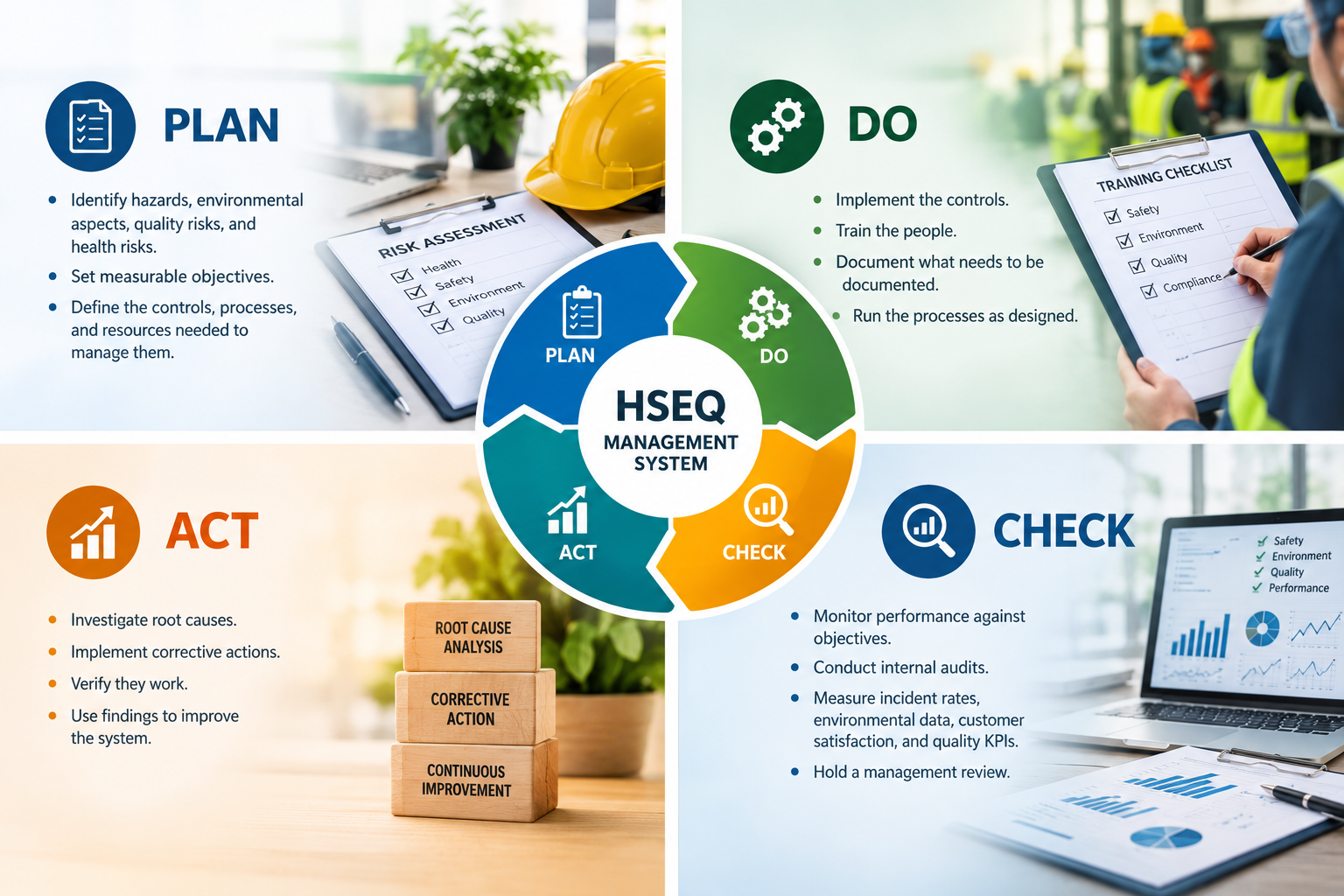
All four components of an HSEQ system operate on the same underlying logic, the Plan-Do-Check-Act (PDCA) cycle, which ISO embeds into every management system standard:
- Plan: Identify hazards, environmental aspects, quality risks, and health risks. Set measurable objectives. Define the controls, processes, and resources needed to manage them.
- Do: Implement the controls. Train the people. Document what needs to be documented. Run the processes as designed.
- Check: Monitor performance against objectives. Conduct internal audits. Measure incident rates, environmental data, customer satisfaction, and quality KPIs. Hold a management review.
- Act: When monitoring or audits identify gaps, investigate root causes, implement corrective actions, and verify they work. Use findings to improve the system.
What distinguishes a mature HSEQ system from a basic one is what happens in the Act phase. Organisations that genuinely improve their HSEQ performance use audit findings, near-miss data, and performance trends to change how they operate, not just to close the paperwork loop. An HSEQ system that consistently produces the same audit findings year after year is not a system that is working.
The role of ISO standards: ISO 9001, ISO 14001, and ISO 45001 do not prescribe what your HSEQ system must look like. They specify what it must do. This means a construction company and a pharmaceutical manufacturer can both hold all three certifications while operating completely different HSEQ systems, as long as both systems satisfy the same outcome-based requirements.
Why Does HSEQ Certification Matter?
For many organisations, the most immediate reason to formalise their HSEQ system is commercial. ISO 9001, ISO 14001, and ISO 45001 certification is increasingly a prequalification requirement for major contracts in oil and gas, construction, government supply, and manufacturing, across the Middle East, UK, USA, and beyond. Without certification, bids are disqualified before they are assessed on merit.
Beyond the commercial driver, the operational case is equally clear. Organisations with structured HSEQ systems consistently outperform those without on every measurable dimension: lower injury rates, fewer environmental incidents, higher customer retention, fewer product failures, lower insurance premiums, and more predictable operational performance. The system works because it forces organisations to think systematically about risk rather than reactively.
The integration of all four disciplines into a single system, rather than running separate health, safety, environmental, and quality programmes, also delivers significant efficiency gains. One management review instead of four. One internal audit programme instead of four. One corrective action register. One set of documented information. These are not trivial savings for organisations that operate at scale.
How to Build an Effective HSEQ System
The starting point for any HSEQ system is a gap assessment, a systematic comparison of your current management practices against the requirements of the relevant ISO standards. This tells you what you already have, what needs to be built, and how long implementation is likely to take.
From there, the implementation sequence follows a consistent pattern: establish context and leadership commitment, identify hazards and environmental aspects, build the documentation architecture, implement operational controls, train the workforce, run internal audits, conduct a management review, and prepare for third-party certification.
The most common mistake organisations make is treating HSEQ implementation as a documentation project rather than an operational one. Certification auditors do not evaluate the quality of your procedures, they evaluate whether those procedures are followed on the ground, whether workers understand them, and whether the system is generating genuine performance improvement over time.
HSEQ Professionals supports organisations through every stage of this journey, from initial gap assessment and ISO management systems consulting through to ISO standards training and certification audit preparation. Our technical and auditing services team also supports organisations with internal audit delivery and pre-certification readiness reviews.
Ready to Build or Certify Your HSEQ System?
Whether you are formalising an HSEQ system for the first time, pursuing ISO 9001, ISO 14001, and ISO 45001 certification, or building internal HSEQ audit capability, HSEQ Professionals delivers the training, consulting, and auditing support you need.
Contact our team to discuss your HSEQ system requirements, or explore our full ISO training catalogue for upcoming courses in Saudi Arabia, Pakistan, the USA, and online globally.