
Risk Assessment Methods Every HSEQ Professional Should Know
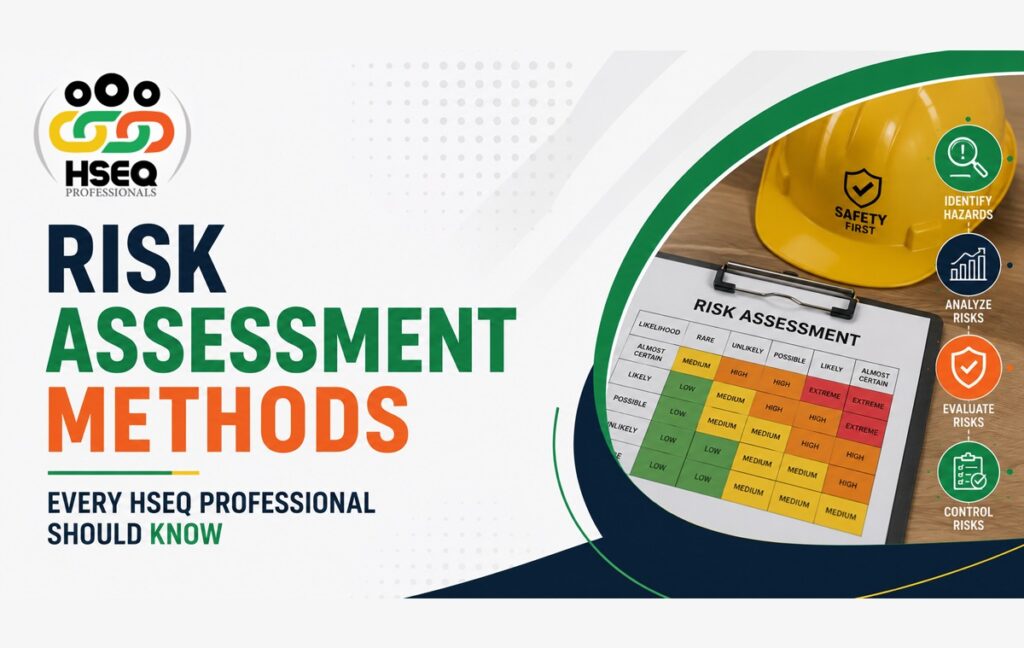
Every serious incident investigation ends with the same uncomfortable question: was this risk ever properly assessed? In most cases, a risk assessment existed on paper, but the method behind it was too generic, too outdated, or too rushed to catch the hazard that eventually caused harm.
Risk assessment is not a single technique. It is a toolbox, and the HSEQ professional’s job is to know which tool fits which situation. A qualitative risk matrix that works well for a routine office hazard will miss critical failure points on a process plant. A checklist that suits a construction site walkthrough will not surface the systemic risks in a new chemical process.
At HSEQ Professionals, we train and consult on risk assessment across construction, oil and gas, manufacturing, and healthcare sites throughout the USA, Saudi Arabia, and Asia. This guide breaks down the risk assessment methodology every HSEQ practitioner should have in their toolkit, the five stages of risk management that structure the process, and the questions that separate a meaningful assessment from a paperwork exercise.
What Is Risk Assessment and Why It Matters
Risk assessment is the process of identifying hazards, analysing the likelihood and severity of harm they could cause, and determining whether existing controls are adequate. It sits at the core of every major HSE management system standard, including ISO 45001, ISO 31000, and OSHA’s General Duty Clause requirements.
Done well, risk assessment does three things for an organisation:
- It gives leadership an evidence-based picture of where the organisation’s real exposure lies, rather than a subjective sense of what ‘feels’ dangerous.
- It prioritises limited safety budgets toward the hazards most likely to cause serious harm.
- It creates a defensible record that regulators, auditors, and insurers can rely on.
Done poorly, a risk assessment becomes a static document that gets copied from year to year, never reflecting how the workplace has actually changed.
The 5 Stages of Risk Management
Before choosing a specific method, every HSEQ professional needs to understand the broader risk management process it sits inside. Regulators and standards bodies, including the UK’s HSE and ISO 31000, generally structure this into five stages.
Stage 1 – Identify the Hazards
Walk the workplace, review incident and near-miss data, consult workers, and examine process documentation to identify anything with the potential to cause harm: physical, chemical, biological, ergonomic, or psychosocial.
Stage 2 – Decide Who Might Be Harmed and How
Identify the specific groups exposed to each hazard, employees, contractors, visitors, or the public, and describe the mechanism of harm. This step is often rushed, but it directly shapes which controls will actually work for the people involved.
Stage 3 – Evaluate the Risk and Decide on Controls
Assess the likelihood and severity of harm for each hazard, then apply the hierarchy of controls: elimination, substitution, engineering controls, administrative controls, and PPE as the last line of defence.
Stage 4 – Record the Findings and Implement Controls
Document the assessment, assign ownership for each control, and set implementation timelines. A risk assessment that is never actioned carries no real value regardless of how thorough the analysis was.
Stage 5 – Review and Update the Assessment
Risk assessments are not one-time documents. They should be reviewed on a set schedule, and immediately after any incident, near miss, process change, new equipment installation, or regulatory update.
Risk Assessment Methodology: Core Methods Every HSEQ Professional Should Know
Within that five-stage framework, several distinct methodologies exist for actually identifying and analysing risk. The right choice depends on the complexity of the operation, the type of hazard, and the level of detail regulators or clients require.
- Qualitative Risk Matrix: Rates likelihood and severity on a scale (e.g. 1–5) and plots them to produce a risk rating of low, medium, or high. It is fast, easy to train workers on, and remains the most widely used method for routine workplace hazards.
- Job Safety Analysis (JSA) / Job Hazard Analysis (JHA): Breaks a specific task down into individual steps and identifies the hazards and controls at each step. This is the standard method for task-based risk assessment before non-routine or high-risk work begins.
- Hazard and Operability Study (HAZOP): A structured, team-based review used mainly in process industries to examine deviations from design intent in a system or process, commonly applied during the design phase of chemical and oil and gas facilities.
- Failure Mode and Effects Analysis (FMEA): Examines individual components or process steps to identify how they could fail, the effect of that failure, and its likelihood and severity, producing a Risk Priority Number to guide corrective action. Widely used in manufacturing and quality-driven environments aligned with ISO 9001.
- Bow-Tie Analysis: Visually maps a hazard’s causes on one side and its consequences on the other, with the preventive and mitigative controls sitting in between. It is particularly effective for communicating major accident hazards to both technical and non-technical audiences.
- Fault Tree Analysis (FTA): A top-down, logic-based method that works backward from an undesired event to identify the combination of failures that could cause it. Commonly used for high-consequence, low-frequency events in high-hazard industries.
- What-If Analysis: A brainstorming-based technique where a team poses ‘what if’ questions about a process or activity to surface risks that more structured methods might miss. Often used alongside HAZOP for a broader initial screening.
- Quantitative Risk Assessment (QRA): Assigns numerical probabilities and consequence values to risks, often using historical data or modelling, to calculate risk in measurable terms such as individual risk per year. Reserved for high-hazard facilities where regulators require numerical risk criteria.
No single method covers every scenario. Mature HSEQ programs typically combine a qualitative matrix for day-to-day operational risk with JSAs for task-level work, and reserve HAZOP, FMEA, or QRA for higher-complexity processes and design reviews.
How to Conduct a Risk Assessment: Step-by-Step
- Define the scope. Decide whether the assessment covers a task, a process, a piece of equipment, or an entire site.
- Assemble the right team. Include workers who actually perform the task, not just supervisors, since they hold the most accurate knowledge of real-world hazards.
- Identify hazards systematically. Use a structured method rather than relying on memory. Walk the actual work area whenever possible instead of assessing from a desk.
- Select the appropriate methodology. Match the method to the complexity of the hazard, using the guidance in the section above.
- Analyse likelihood and severity. Apply your chosen scoring or modelling approach consistently across the assessment.
- Determine controls using the hierarchy of controls. Always start at elimination and substitution before defaulting to PPE.
- Assign ownership and timelines. Every control needs a named owner and a completion date, not just a description.
- Document and communicate findings. Share the outcome with everyone exposed to the risk, not only with management.
- Set a review date. Build the review into your management system so it is not left to memory.
Risk Assessment Questions Every HSEQ Professional Should Ask
A strong risk assessment methodology is only as good as the questions behind it. Before signing off on any assessment, HSEQ professionals should be able to answer:
- What could realistically go wrong here, not just what has gone wrong before?
- Who is exposed, and does that include contractors, visitors, or nearby operations, not only direct employees?
- What is the worst credible outcome, rather than the most likely one?
- Are the existing controls actually functioning as designed, or only functioning on paper?
- Has anything changed since the last assessment: equipment, personnel, process, or environment?
- Does the chosen risk assessment methodology match the complexity and consequence level of this specific hazard?
- Who is accountable for each control, and when will it be verified?
Common Mistakes to Avoid
- Using the same generic risk matrix for every hazard regardless of complexity.
- Assessing risk from a desk instead of observing the actual task or process.
- Treating the risk assessment as a compliance document rather than a working tool.
- Failing to involve the workers who actually perform the task.
- Leaving assessments unreviewed after process changes, new equipment, or incidents.
Choosing the Right Method for Your Organisation
There is no universally ‘correct’ risk assessment methodology. The right approach depends on your industry, the maturity of your HSE management system, and what your certification body or regulator expects to see. A construction contractor may rely heavily on JSAs and a qualitative matrix, while a petrochemical facility will need HAZOP, Bow-Tie analysis, and quantitative modelling built into its ISO 45001 and process safety framework.
What matters most is consistency: a documented methodology, trained assessors, and a review cycle that keeps the assessment aligned with how the workplace actually operates.
Build Risk Assessment Capability Across Your Organisation
HSEQ Professionals delivers ISO 45001 and ISO 31000 consulting, risk assessment training, and technical auditing services to organisations across the USA, Saudi Arabia, and Asia. Our IOSH and NEBOSH-aligned training programs equip HSEQ teams with the practical skills to select and apply the right risk assessment methodology for their operations.