
Types of Workplace Hazards: A Complete Guide and the Training That Controls Each One
Most workplace injuries are not freak accidents. They come from hazards that were visible, known, and left unmanaged: a worn guardrail, an unlabelled drum, a supervisor who was never taught to spot fatigue.
This guide covers the main types of workplace hazards, gives workplace hazard examples for each, and explains how to control them using the hierarchy of controls. Where training is the right control, we point to the course that fits. It draws on the HSE training and consulting that HSEQ Professionals delivers across the USA, the Middle East and Asia.
What Is a Workplace Hazard?
A hazard is anything with the potential to cause harm: a chemical, a machine, a working position, an impossible deadline. Risk is how likely that harm is, combined with how severe it would be. A ladder is a hazard. Whether it is a high risk depends on the height, the surface and who is climbing it.
The hazards that injure people instantly get the attention, but they are not the biggest killer. The International Labour Organization estimates that around 2.93 million workers died from work-related causes in 2019, and about 89% of those deaths came from occupational disease rather than accidents (ILO). The hazards you cannot see on the day deserve the most deliberate management.
The 6 Main Types of Workplace Hazards
Frameworks group hazard categories slightly differently, and some list four rather than six. These six cover what you will meet on almost any site.
1. Safety Hazards
These cause immediate injury: falls from height, unguarded machinery, live electrical equipment, confined spaces, fire, and moving vehicles. Slips, trips and falls on the same level remain among the leading causes of non-fatal injury in most national statistics. Examples: roof work, entering a tank, isolating a panel, forklifts operating near pedestrians.
Training: Working at Height, Confined Space Safety, Electrical Safety Specialist, Basic Fire Fighting and Defensive Driving.
2. Physical Hazards
Environmental factors that harm without direct contact: noise, vibration, heat and cold stress, radiation and poor lighting. Heat stress needs particular attention in hot climates, where outdoor crews are exposed for months at a time. Examples: a noisy fabrication shop, outdoor work in summer, hand-arm vibration from power tools.
Training: IOSH Working Safely for awareness, and OSHA 10-hour or 30-hour programmes for supervisors.
3. Chemical Hazards
Solvents, acids, fuels, welding fumes, dust and cleaning products can harm through inhalation, skin contact or ingestion, and the effects are often delayed. Control starts with knowing what is in the container: labels and safety data sheets. Examples: paint thinners in a poorly ventilated room, silica dust from cutting concrete.
Training: IOSH Managing Safely for managers and OSHA 10/30 for hazard communication basics.
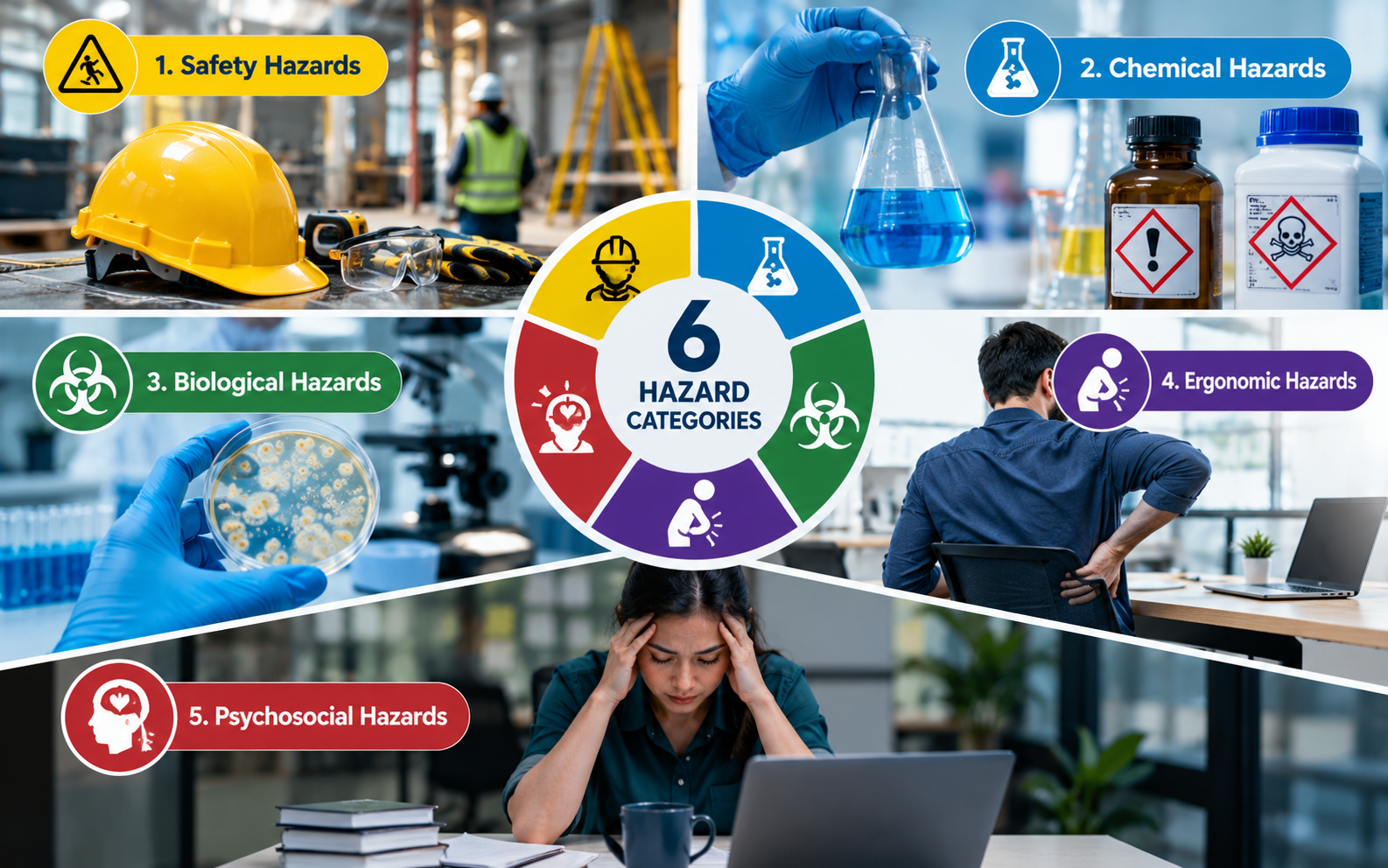
4. Biological Hazards
Bacteria, viruses, mould, blood-borne pathogens, contaminated water and animal or insect exposure. They are obvious in healthcare, waste and food handling, but they also appear in ordinary buildings through poor ventilation and water systems. Examples: needle-stick injuries, legionella in cooling systems.
Training: IOSH Working Safely for awareness, and Saudi Heart Association training for emergency response.
5. Ergonomic Hazards
Manual handling, repetitive tasks, awkward postures and badly set up workstations. The injury usually appears months after the cause, which is why it gets missed. Examples: lifting heavy boxes repeatedly, a monitor set too low, long periods of driving.
Training: Safety at Workplace and Health & Safety Officer Training for those who run task and workstation assessments.
6. Psychosocial Hazards
Excessive workload, long hours, bullying, violence, job insecurity and poor support. WHO/ILO joint estimates link long working hours to more work-related deaths than any other single risk factor they measured. Examples: sustained overtime, unmanaged conflict, isolated lone working.
Training: Safety Leadership & Supervision, since supervisors shape workload and culture, and ISO 45001 for building it into the management system.
How to Control Workplace Hazards: The Hierarchy of Controls
The hierarchy of controls ranks control measures from most to least effective. It is used by NIOSH and OSHA, and ISO 45001 (clause 8.1.2) requires organisations to apply it. Take roof maintenance as a running example:
- Elimination: Remove the hazard. Prefabricate components on the ground so nobody needs to be on the roof.
- Substitution: Swap in something less hazardous, such as a mobile elevated work platform instead of a ladder.
- Engineering controls: Isolate people from the hazard with guardrails, edge protection and covers over fragile skylights.
- Administrative controls: Change how people work through permit to work, safe systems of work, inspections, signage and training.
- PPE: Protect the individual with a harness and lanyard when the measures above are not enough on their own.
Two points matter in practice. Controls higher up are more reliable because they do not depend on someone remembering to do the right thing. And training is an administrative control, so it supports the controls above it rather than replacing them. A well-trained worker on an unguarded roof is still at risk.
4 Common Mistakes in Workplace Hazard Control
- Reaching for PPE first: It is the last line of defence, not the opening move.
- Assessing once and filing it: Review whenever equipment, processes, materials or staffing change, and after every incident or near miss.
- Ignoring health hazards because nobody has been hurt yet: Noise, dust and stress cause harm slowly, so the absence of injuries proves little.
- Training only frontline workers: Supervisors and managers decide how work is planned and paced, so they need the competence too.
How HSE Training Helps Control Workplace Hazards
Training earns its place in three ways: it teaches people to recognise hazards early, it makes administrative controls such as permit to work actually function, and it gives supervisors the competence to enforce everything above them. A good starting point is Hazard Identification & Risk Assessment. From there, workers can take IOSH Working Safely, managers IOSH Managing Safely, and the people running safety day to day Health & Safety Officer Training. The full range sits in our OSH Academy courses. For individuals it builds a recognised credential; for employers it shows regulators and clients that the workforce is competent.
How to Prevent Workplace Hazards Before They Cause Incidents
HSEQ Professionals provides accredited HSE training, consulting and technical auditing to help organisations identify and control hazards on site. See the training calendar or contact our team to discuss the right programme for your workforce.
Frequently Asked Questions
- How many types of workplace hazards are there?
Commonly four to six. We use six: safety, physical, chemical, biological, ergonomic and psychosocial. Some frameworks fold physical hazards into safety hazards.
- What is the most effective way to control a hazard?
Eliminate it. If that is not possible, work down the hierarchy of controls: substitution, engineering controls, administrative controls, then PPE.
- Is training enough to control a hazard?
No. Training is an administrative control and works best alongside engineering controls and sound procedures.